

 Write a comment
Today we look Ireland’s former Taoiseach and president Éamon de Valera and the day he came to Newry in defiance of an order banning him from entering the North.
Taken from The Providence News dated 8th February 1929 with the headline ‘Sinn Fein leader jailed’.
An exclusion order had been issued to de Valera banning him from entering the North, an exclusion order he rejected out of hand. He had in fact been arrested in Newry Town hall 5 years before this.
Previously de Valera had been arrested after sneaking into the town hall amid massive B-Special and RUC presence and he was taken to Newry train station the next morning and told in no uncertain terms not to return to 'Ulster', he quipped, (long before Arnold Schwarzenegger) ‘I’ll be back’.
Of course, de Valera had a point, he was standing for election in the south Down district having shunned the Dail, saying at a meeting in Ennis Co Clare that the Dail was a ‘Partitionist Parliament.’
One might be forgiven by thinking this was a well planned effort from de Valera as he was already making moves to enter Leinster House saying, ‘Things may be forced on us. We may temporarily have to submit to certain things, but our assent they never can gain. Don't forget for a moment that there is a vast difference between patiently submitting, when you have to, for a time, and putting your signature to a consent, or assent to these conditions.”
So, he was seemingly laying the marker for an entry to the treaty established parliament by his words, suggesting it was not impossible while also insisting that he would not sign his affirmation to the oath. Coincidentally he won the south Down seat and Sinn Fein’s vote went up across several by elections in the republic as a direct consequence.On the Newry arrest however, in 1929 he was en-route to Belfast in order to open the Gaelic bazar. Word of his arrest spread quickly through Newry and by the time he reached the courthouse he was greeted by a large number of supporters.
When answering the questions put to him by the magistrate, de Valera answered only in Gaeilge. "Irish is not the language of these courts," the magistrate responded, "the official language is English."
De Valera was sentenced to one months imprisonment.
Write a comment
Emily Cordner was born in Newry in 1859 to her parents William Henry Cordner and Matilda Cordner (née McCracken). Her parents owned a jewellery and watchmaker’s shop, which according to the Belfast and Ulster Street Directory 1852 was located at 46 Hill Street, Newry.
On the 31st January 1894, at Warrenpoint Remonstrant Presbyterian Church, Emily married the Reverend Samuel Pinkerton, who was minister of First Newry Presbyterian Church. Samuel added his wife’s surname to his own which was most uncommon. The couple were fascinated in Irish nationalism and in particular John Martin and John Mitchel, who were affiliated with Newry. John Mitchel’s father had also been a minister in First Newry Presbyterian Church.
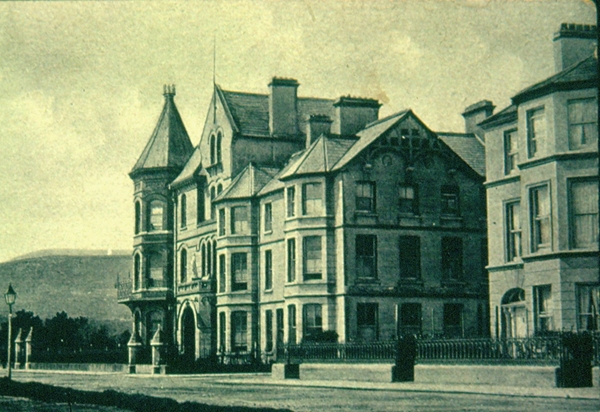
Emily Cordner-Pinkerton was a music teacher and publisher. She was responsible for compiling The Open Window, which was first published in 1897, and was the first of five annuals. The annuals were a combination of much local interest, historical articles, reflections on contemporary life and the importance of the Irish language. It also featured a vast array of advertising. The annuals were very well produced and contained many photographs, often captured by the Cordner-Pinkertons themselves.
An advertisement for The Open Window 1897-1898 edition describes the annual as “More Acceptable that a Christmas Card for Newryers and Acquaintances from home!” It contained a mix of articles, with Part I devoted to the general reader, Part II devoted to the tourist and Part III devoted to the local Annals. One such article was entitled “Advance Newry: An Epitome of the Year’s Improvements, and the Outlook for next Year”. Described as “the best possible 6d worth of the year” it could be purchased at J. Warnock & Co., Irwin & Co., Miss McConville, Sugar Island, the Misses Taylors’, Hill St. and all stationers and newsagents.
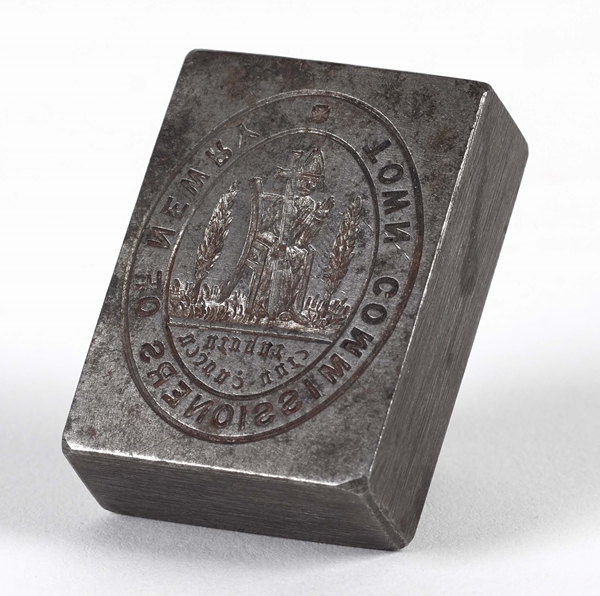
The 1898-1899 edition contained an article on “The Newry Seals”, which depicts three seals, two of the exempt jurisdiction of Newry and one engraved in brass by Magennis of Newry for the Town Commissioners in 1871.
In the Newry Reporter, dated 14th December 1900, the annual was again depicted as a success. “Each year of its existence has seen some improvement in ‘The Open Window’ and the editorial motto being ‘Excelsior’, we must regard the current issue as the last and best until the next.” Many of the features involved in that years publication had local themes. Under the heading ‘The Death Roll’, a series of obituary notices of Newry people who had passed away during the year, included photographs of the late Mr. James Burns, the late Mr. H. B. Moorehead J.P. Lord Russell’s of Killowen’s death received considerable attention, and a full-page portrait of the distinguished Newry man was published.”
Emily had contracted rheumatic fever as a young child, which subsequently led to a lifetime of poor health. She died of heart failure on 2nd August 1902, leaving behind four children, the oldest being seven years old. Her husband died of tuberculosis less than a year later, on 16th March 1903. Her death notice in the Newry Reporter, 5th August 1902 stated, “The late Mrs. Pinkerton will be long remembered in connection with her clever publication on which she ably chronicled the principal local events of the year and never omitted to add to the stock of our knowledge in things pertaining to the always interesting past, of the Frontier Town.”
Newry and Mourne Museum is open Tuesday – Saturday from 10.00 am – 4.30 pm. A free tour of the main exhibition galleries takes place every Wednesday at 2.00 pm. To book, call 0330 137 4422 or email museums@nmandd.org for further information. You can also find information on their website at www.visitmournemountains.co.uk
Write a comment
Today I look back at my own parish and village, Bessbrook. I discovered a story about the Golden Jubilee of the ordination of the Very Rev. Canon Charles Quinn, P.P., Camlough.
Taken fromThe Freeman’s Journal Sydney Australia dated 13th July 1911 with the headline ‘NEWS FROM IRELAND. A GREAT PRIEST AND PATRIOT HONOURED.—CARDINAL LOGUE’S TRIBUTE.’
Although he was the Parish Priest of Camlough, it would seem he had quite a significant hand in the building of the Convent in Bessbrook, and the schools that adjoin them, a school I attended myself until 1991 under the stewardship of Sister Finbar (those were the days).
The news clip stated, ‘He had erected a new convent at Bessbrook, which was one of the most magnificent edifices in Ireland, and he had attached to that convent schools which had no parallel throughout the whole country.
‘In addition, he had succeeded in making the teachers of his schools comfortable by building residences for them.’
Quinn was born in the highlands of Kildress, from an old County Tyrone family, who trace their ancestry back to the royal line of the O’Neill's. On being ordained a priest he was appointed a curate in Cookstown, and having served in the ministry in Dungannon and Armagh was promoted to the pastorate of Lower Kiileavy in 1874.
He seemed to be a man that was to the fore in the community, however he was outspoken too. From one article I unearthed he threatened to ban Irish from the schools of his parish because he claimed that ‘Sinn Fein turned the Gaelic League into a political machine.’
Whilst reading into Canon Quinn’s family history, I found this on his family tree: CANON CHARLES QUINN.P.P.V.G. born 1833, BEAGHMORE CO.TYRONE, Occupation: PROMINENT CLERIC (ARMAGH), BURIED CARRICKRUPPEN CAMLOUGH CO ARMAGH.
Canon Quinn died 4.5.1925, LOWER KILLEAVEY CO. ARMAGH, buried MAY 1925, CARRICKRUPPEN NEAR CAMLOUGH CO. ARMAGH. Charles ordained Maynooth 14.6.1862. Appointments: 1863 Curate Drumglass.1864- 1872 curate Armagh. 1873 administrator Armagh.1875-1924 P.P. Lower Killeavey.
He celebrated his golden jubilee in Bessbrook on Sunday 4th June 1941. A separate folio of papers exist on this man which is worth reading. Charles and his brother Bernard crashed on their pony and trap on September 18th 1902 and as the local newspaper said “the venerable pastor hurt his legs”.
A man I knew very little about if truth be told, but a man no less worthy of mention as we look back at historical moments and figures from the Newry and Mourne area.
Write a comment
The mill race was a crucial part of Newry’s industrial past, channeling water to power mills.
Early maps, such as the Lythe Map of 1570, indicate the existence of watercourses outside the town walls that predate the mill race itself. These may have been used by Cistercian monks to irrigate orchards and gardens before the abbey’s dissolution in 1548. A dotted line on the map follows the path of the later Mill Race at least as far as Lower Water Street to a large body of water, with the note ‘These black pyrches does give us a very good plan for a mylne dame’. Despite these plans for a Mill dam, it is likely that a Mill race was built instead. Historian Peter Sinclair suggests that race was likely constructed in the late 16th century under Nicholas Bagenal’s direction. A 1588 grant from Nicholas and Henry Bagenal to Patrick Creely (Crilly) of Newry included land, two water mills, watercourses, and weirs on the Clanrye River. A 1612 inquisition records that Newry had two mills and two weirs—one for salmon and the other for eels—most likely situated in the Mill Street area.
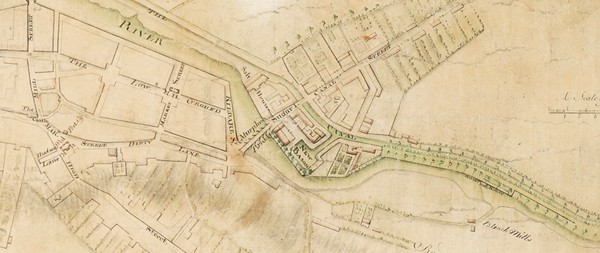
Maps from the 17th and 18th centuries provide further insights. A 1624 map of Carlingford Bay shows Mill Street, then a small settlement with about six to eight buildings. By 1703, the Neville Survey reveals an expanded Mill Street with around 10-12 buildings. This survey includes the earliest known depiction of the mill race, which ran from Trevor Hill to an area now known as O’Hagan Street where the race reconnects with the river. A building near the race in this survey is likely one of the original water mills referenced in the 1588 grant.
The 1760 Rocque Map illustrates the mill race winding through Newry, running alongside the river at Trevor Hill before disappearing and reappearing under various streets including Kildare Street, Margaret Street, Back Lane and Mill Lane (The latterly two becoming Water Street). Lower water Street, historically referred to as, “the back of the dam,” likely derived its name from the mill race, which was possibly dammed in places to regulate water flow. The street layout during this time suggests that bridges were built across the race to accommodate growing urban development.
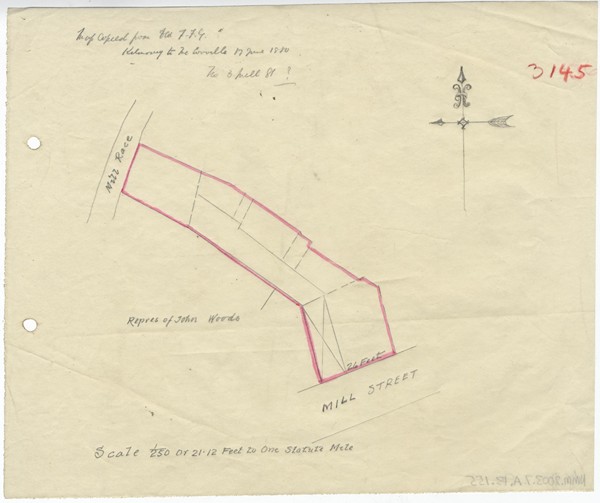
The 1761 Wren Map and the first edition Ordnance Survey map provide even greater detail about the mill race’s origin. It appears to have been a diverted tributary of the Clanrye River, beginning in the area opposite to where the Linen Hall Arch on the Canal Quay is (behind Glin Ree Court) and running diagonally towards bleach mills in the area of Downshire Road Orange Hall. From there, it followed Downshire Road into town, continuing along Trevor Hill. The bleach mills are documented in a 1767 advertisement in the Belfast Newsletter, which describes a facility capable of bleaching 2,000 pieces of linen per season, complete with water supplies, furnaces, drying lofts, and living quarters for workers.
By 1815, Newry Magazine recorded the transformation of the low ground area, (nowadays Hill Street area) with an elderly resident, Charles Havern, recalling when it had been a marshland. He also remembered two bleach greens near what later became the Commercial Coffee Rooms in 1794, now the site of Jack Murphy’s Jewellers and Santander Bank. This area, known as Seymour’s Green, was likely named after a local linen manufacturer. In 1786, William Drennan, a physician who would become a prominent United Irishman, referenced the race in a poem to Miss Courtney, describing it as a picturesque part of Water Street, where “the nightly cascades shall resound in her ear / And the mill race runs by so sweet and so clear.” A future article will deal with the arching over and enclosure of Newry’s mill race.
The Museum is currently offering free tours of the main exhibition galleries on Wednesdays at 2.00 pm. These must be booked in advance by calling their Education Officer at 0330 137 4422.
Newry and Mourne Museum is open Tuesday – Saturday 10.00 am – 4.30 pm. Please call 0330 137 4422 or email museums@nmandd.org for further information.
Visit their website at www.visitmournemountains.co.uk
Write a comment
It would seem that the Newry IRA in 1972 came up with an ingenious plan to infiltrate the British Army in the town by threatening to dress as British soldiers. The week previous to this a telephone threat was received by the British commander in the north of Ireland stating that almost 200 British soldier uniforms were stolen from a launderette in Derry.
The article however, dated 5th February 1972, from the Star newspaper, does shed light on the horrendous conditions the people of Newry had to live under, effectively martial law seemed to be in effect in the town.
An estimated 4,000 troops were deployed in the town after a protest march in anger at the massacre that the people witnessed happening in Derry a week earlier when British Paratroopers murdered 13 innocent civilians.
On 30th January 1972, in an ‘illegal’ Civil Rights march, the British Army deployed the 1st Battalion of the Parachute Regiment on to the streets of Derry to quell fierce rioting.
The Paratroopers indiscriminately opened fire on protestors, murdering 13 innocent civilians and injuring scores more.
The events of Bloody Sunday were broadcast all over the world and caused outrage and revulsion. The British government made an already volatile situation worse by claiming that all 13 killed were “gunmen and men carrying nail bombs” – a point ferociously denied by thousands of witnesses in Derry’s Bogside area and many Catholic clergymen who were there on that fateful day.
The ministry of defence claimed that IRA snipers opened fire first at British soldiers, trying to justify the huge death toll.
Furthermore, such disregard for human life put the British Government under severe pressure to address exactly what had happened. Northern Ireland was on the brink of civil war. Nationalists were disgusted at the treatment of their community and now had a siege mentality, creating Catholic ghettos free from the British Army and RUC personnel.
Meanwhile, Protestants became more alarmed that the situation may lead to a British withdrawal from the North and thus the UVF and UDA vowed to protect the union at all costs. A Provisional IRA man at the time argued that Bloody Sunday was “the greatest recruitment drive for the IRA” – as it turned non-political young people into Provisional IRA activists.
Tensions and emotions in Newry were clearly at breaking point. One must point out, the British army spokesperson really didn’t help matters when he released a statement saying that the reason there was such a heavy British military presence in Newry was ‘to prevent another Bloody Sunday’.
Every road leading to and from Newry was sealed off by British army road blocks in armoured vehicles. This, in hindsight, was noted by many as an act of intimidation and a clear ploy to try and scare people away from the protest march.
In Dublin An Taoiseach, Jack Lynch pleaded with protesters “not to do anything that would give the British an excuse to open fire again as it did in Derry”.
Turbulent times indeed to be living in Newry and the surrounding areas, but times, that have undoubtedly made the areas stronger and more united.
Write a comment
Lent, the period of six weeks leading up to Easter is one of the most important dates in the Christian calendar. This year Ash Wednesday falls on Wednesday 5 March and for the next forty days, Christians all over the world prepare to commemorate Jesus’s Resurrection on Easter Sunday through prayer, reflection, and fasting. In this article we will look at some of the practices associated with this time of year.
The tradition of Lent is based on the suffering and temptations that Jesus went through during his stay in the wilderness for 40 days and 40 nights. 40 is an important number for the Christian religion, as it is closely associated with important biblical events.

The day before Lent starts is Shrove Tuesday, also known as Pancake Tuesday. This day was traditionally the last chance to use up the foods Christians would not be eating during Lent, such as such as meat, fish, eggs, fats, milk, and sugar. Shrove comes from the verb 'to shrive' which means to confess sins. The overindulgence in rich foods on Shrove Tuesday also gave rise to the alternative name of "Mardi Gras" meaning "Fat Tuesday" in French, which has grown into a carnival in Louisiana, USA.
Ash Wednesday is the beginning of Lent with many Christian churches holding services during which the congregation are marked on the forehead with a cross of ashes. This tradition goes as far back to the second century when Lent was a period of preparation of candidates for baptism and a time of penance for grievous sinners who were excluded from receiving Holy Communion and were preparing for their restoration. As a sign of their penitence, they wore sackcloth and were sprinkled with ashes.

This form of public penance began to die out by the 9th century. It became customary for all the faithful to be reminded of the need for penitence and of their own mortality by receiving a memento mori in the form of ashes, either sprinkled on top of worshippers’ heads or marked in the shape of a cross on their foreheads, on the first day of Lent, Ash Wednesday.
Historians generally agree that the 40-day period before Easter, known as Lent, emerged shortly following the Council of Nicaea (now Iznik in Turkey) in 325 AD. Earlier observances of Lent seem to have focused particularly on the practice of fasting. The actual 40-day period varied region-to-region, even church-to-church; some including weekends, some not; some fasting Sundays, others not. However, in every case, fasting rules were strict. One meal a day was allowed in the evening, and meat, fish, eggs, and butter were forbidden.
By the 800s, the strictness of the fast began to relax. By the 1400s, Christians had begun eating the one meal earlier in the day and later began to add a smaller meal to keep up their strength for work.
Eating fish was allowed, and later eating meat was also allowed through the week except on Ash Wednesday and Friday. Dispensations were given for eating dairy products if a pious work was performed, and eventually this rule was relaxed totally. However, the abstinence from even dairy products led to the practice of blessing Easter eggs.
Over the years, Lent has become less strict in almost every western tradition. In the Catholic Church, for example, the number of obligatory fasting days decreased from six days a week to three, and then eventually, to just two in the whole season of Lent: Ash Wednesday and Good Friday (having only one full meal a day and smaller snacks to keep up one’s strength).
Palm Sunday marks the beginning of Holy Week, the last week of Lent leading up to Easter, which finishes on Easter Sunday, the day on which Jesus rose from his tomb.
Today giving something up, such as sweets, alcohol, or social media has become the focus of Lent, but for all these changes, the tradition of Lent is still largely recognizable to what it was nearly 2,000 years ago.
Newry and Mourne Museum is open Tuesday – Saturday 10.00 am – 4.30 pm.
They currently offer free tours on Wednesdays at 2.00 pm. These must be booked in advance by calling 0330 137 4422 or email museums@nmandd.org for further information
Visit the Museum website at www.visitmournemountains.co.uk
Write a comment
The Order of St Patrick was founded by King George III in 1783 as a means of rewarding or gaining support in the Irish Parliament. Francis, third Earl of Kilmorey, of Mourne Park, near Kilkeel, was MP for Newry from 1871 to 1874 and was elected to the House of Lords six years later. In 1888, the Earl wrote to the Prince of Wales pressing his claim for inclusion in this illustrious order of chivalry.
‘May I venture to ask Your Royal Highness to use your powerful influence…in securing for me the vacancy in the Order of St Patrick … I have consistently supported my party for 20 years in both Houses, I am the holder of an Irish title, dating from the time of Charles II. I am one of the largest land proprietors in Ireland, and Your Royal Highness knows an active member of society on both sides of the channel. This is the only distinction I can aspire to.’

The Prince of Wales passed the letter on to the Prime Minister, the Marquess of Salisbury, asking for the Earl’s name to be considered, but Francis had to wait 2 years before he was invested in the Order in 1890.
For important occasions, such as Coronations and investitures of new members of the Order, Knights of St Patrick wore elaborate vestments:
The Earl of Kilmorey’s mantle, on display in Newry & Mourne Museum, is a blue robe lined with white silk lining, with gold and blue silk cordons with large tassels, and a detachable hood. The robes had to be made in Ireland from silk or satin ‘wrought in Ireland’. A metal star of the Order is attached to the mantle made by Robinson & Steel of Dawson Street, Dublin.
The Theft of the Irish Crown Jewels
On 6 July 1907, four days before King Edward VII was due to visit Ireland to conduct the investiture of Lord Castletown, the insignia of the Grand Master of the Order of St Patrick, known as the Irish Crown Jewels, were declared missing. The star, badge, and collar featuring Brazilian diamonds together with emeralds and rubies would be valued at over £4 million today.

The insignia was held in Dublin Castle, under the protection of the Ulster King of Arms, Sir Arthur Vicars. Unfortunately, he was known to be ‘a notoriously forgetful and casual sort of creature’ with some rather dubious friends.
Some Members of Parliament blamed Unionists who were seeking to embarrass Irish nationalists. Others blamed Irish nationalists. It was even claimed that the Royal Household had staged the robbery to secure the jewels before any Home Rule bill was enacted.
Vicars accused Francis Shackleton, Dublin Herald at Arms and brother of the Antarctic explorer Ernest. Shackleton, a socialite constantly short of money was thought to have stolen the jewels with the help of Captain Richard Howard Gorges. They allegedly plied Vicars with whiskey and then removed the safe key from his pocket. Shackleton allegedly transported the jewels to Amsterdam where he sold them for £20,000 (about £1.5 million today). Pierce O’Mahoney, the Irish Nationalist politician and Vicars’ half-brother, claimed that the men escaped prosecution due to Shackleton threatening to expose “discreditable doings" - he and Gorges were in a relationship at a time when homosexuality was illegal. A public trial would have involved drawing attention to their friends in the highest echelon of British and Irish society, including the Duke of Argyll, who was married to the King’s own sister. The Scotland Yard report was supressed, and no charges were ever brought.
Vicars was desperate to prove his innocence and recover the jewels, going so far as to enlist the help of psychics. His distant relative Sir Arthur Conan Doyle, creator of Sherlock Holmes, even offered his services.
Frank Shackleton went on to defraud his friend, the sculptor Lord Ronald Gower, of over £60,000 (almost £5 million today,) and was eventually prosecuted and imprisoned, but only for defrauding another friend of a much smaller sum. It is suspected that this was due to the British Government's desire not to provoke Shackleton into naming names.
Sir Arthur Vicars was dismissed from his post by the king and was later shot as an alleged informer by the Irish Republican Army in 1921.
The jewels have never been found.
For more information on objects in the Museum's collections visit www.visitmournemountains.co.uk/
Newry & Mourne Museum is open from Tuesday to Saturday, 10.00am - 4.30pm.
Free tours are available on Wednesdays at 2.00 pm, which must be booked in advance by calling their Education Officer at 0330 137 4422.
Write a comment
Ever since the development of Warrenpoint as a seaside town, the town has always strived to provide several sources of entertainment, from the Promenade, the Warrenpoint Municipal Park and the bandstand that resides within, as well as the local feis and amateur dramatics. However, with the seasonal events, there was also a need for entertainment, and that is where the funfair offers its service. The establishment of funfairs can be dated back to the 18th century where rides were powered using staff pulling ropes before the introduction of steamed powered attractions in the late 19th century elevated the experience and popularity of the funfairs.

Toft and Turnball originally occupied the square in Warrenpoint with their gondolas ride and paid the urban council £2 a week rent. However, in 1904 the council proposed a resolution prohibiting amusements on the Square despite a petition signed by 126 ratepayers asking for the decision to be reversed. It was reported in 1921 that J McGivern argued for having the amusements put back in the square by means of inviting Mr. Lyons from Omeath to perform with his show. By 1931, Thomas McGivern (who founded McGivern’s Amusements in 1920) would be asking permission to use the Square for his own amusements. During the summer months McGivern’s would travel to many counties in Ireland offering the funfair as a form of entertainment. They also took advantage of the lack of cinemas and held picture shows in the winter. Their main form of transportation was the stem engine, their most famous one being the Fowler engine known as the ‘Carry on’ which was bought in 1943. The engine was last used in the 1959 St Patrick's Day celebrations in Dublin (the last time it was in used at a funfair was in 1954 in Belfast.) The ‘Carry on’ tours at rallies and still has ‘McGivern’s Amusements on Tour’ written on it. The McGivern family suffered some setbacks in their business when a fire broke out in the stores in Warrenpoint, destroying their horse machine and the fairground organ. After the purchase of new attractions such as dodgems, chairoplanes, Noah’s Ark and side stalls, the business began to thrive and eventually became permanently based in the Warrenpoint square from May until September.

McGivern’s Funfair finished in 1981 and was succeeded by the Bell family who had been operating on a smaller scale. The amusements eventually came under the name of Dizzylands Funfair. In 2022, the Newry Democrat ran an article on the Bell family’s return to Warrenpoint after closing for two years during the Covid lockdowns. This marked the first time there was no funfair in Warrenpoint in a hundred years. The article made a point to highlight the head of the family, a Mrs Ina Bell as a proud, dedicated member of the family business, who at the time of the article and at 95 years of age was still working in the dodgems. The Dizzyland funfair is still in operation to this day providing entertainment for the many that visit Warrenpoint.
The Museum is currently offering free tours of the main exhibition galleries on Wednesdays at 2.00 pm. These must be booked in advance by calling our Education Officer at 0330 137 4422.
Newry and Mourne Museum is open Tuesday – Saturday 10.00 am – 4.30 pm. Please call 0330 137 4422 or email museums@nmandd.org for further information.
Visit their website at www.visitmournemountains.co.uk
Write a comment
Newry has a long history of firefighting. One of the earliest records dates to 1737 when Richard Needham gifted the town of Newry a fire engine.
Until 1877, firefighting was carried out by Insurance Fire Brigades which only fought fires in buildings which had subscribed to a private company. If a building caught fire, it would only be put out if it posed a risk to an insured building. The insurance company brigades consisted of a few men with a manual pump, some lengths of hose and a nozzle. Members of the public were often drafted in on the spot to help in exchange for a beer allowance.

As Newry was a garrison town, the army, based at Linenhall Square, also has their own fire brigade who would be called out to assist the Insurance Brigades.
The modern fire service as we know it began in 1877 when Newry Volunteer Fire Brigade was formed by a group of businessmen for the protection of the town. Mr R F Maginnis was appointed Captain and Mr A Mc Clelland and Mr A Scott as 1st Officers. The town commissioners funded 12 volunteers, 6 paid men with a manual pump, a hose cart, ladder and a fire escape. The equipment was stored at a fire house on The Mall.
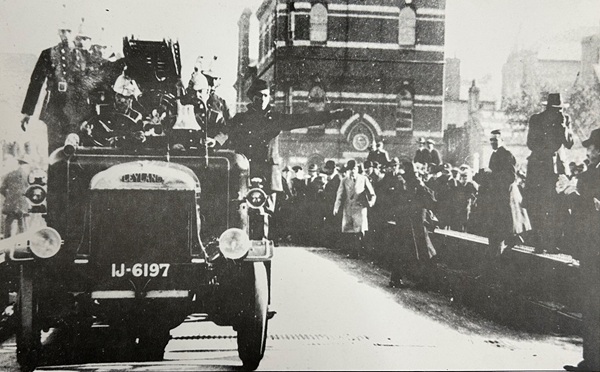
In 1910 a steam horn was fitted to the gas works to mobilise firemen. However, it was quickly replaced by call out boys as the noise caused problems for residents of Chapel Street – it was so loud that an elderly lady died of a heart attack. In 1927 an electric siren was placed on the roof of the town hall.
That same year the fire brigade tackled their biggest fire when a 6-storey flour mill caught fire on Hill Street, the fire spread and engulfed shops and the printworks of the Newry Reporter. Firefighters worked from the roof of Newry Cathedral to extinguish the blaze and tragically Fireman Fegan lost his life.
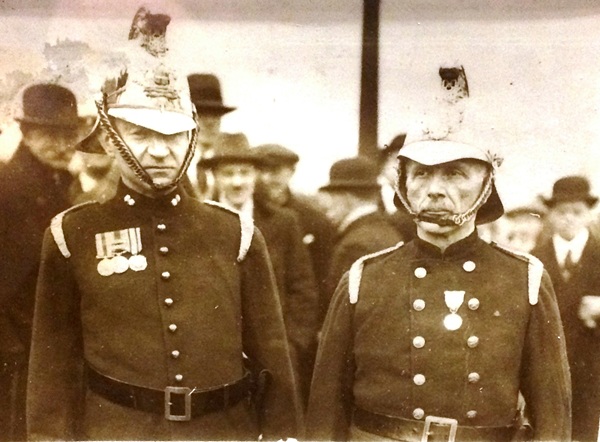
In 1930, James Heather, Hon Captain of the Newry Fire Brigade was the first civilian to be awarded the Kings Police and Fire medal in honour of his “39 years exemplary service distinguished by special merit and ability”. He wore his Newry Fire Service Uniform at the ceremony.
Newry Sub officer and honorary “fire chief of Newry”. Jackie McClelland. was awarded a British Empire Medal in 1972, "for his courage, leadership, and devotion to duty." His son John also served as a fire fighter in Newry and in 1996 became Chief Fire Officer of Northern Ireland.
In the 1960s the Fire Brigade moved to a new station on Cecil Street. As civil unrest increased the fire fighters adapted new tactics for firefighting during riots. Barricades were erected around the town and many decided to stay at the station to be available in an emergency, although the living conditions were spartan as the building had not been designed to house firefighters.
Throughout the 1970s the fire brigade had to adapt to a rise in arson, incendiary devices and bombings. The firefighters were issued with new personal alarms to replace the siren, fire appliances were fitted with 2-way radios and new breathing apparatus was issued.
In the 1990s steps were taken to provide Newry with a full-time fire service and a new station on Edward Street. The new station included accommodation for personnel and fire engines, an open space for a fire drill and a drill tower and is still in use today.
The Museum is currently offering free tours of the main exhibition galleries on Wednesdays at 2.00 pm. These must be booked in advance by calling our Education Officer at 0330 137 4422.
Newry and Mourne Museum is open Tuesday – Saturday 10.00 am – 4.30 pm. Please call 0330 137 4422 or email museums@nmandd.org for further information.
To explore their collections online and for further information please visit their website at www.visitmournemountains.co.uk


 |
 |
 |