

 Write a comment
Newry’s tradition of hosting markets and public assemblies stretches back centuries. A late 16th-century map of Orier identifies a market cross at the foot of High Street, likely the site of the town’s earliest trading activity. In 1613, King James I granted Newry a royal charter, formally establishing it as “The Borough of Newry.” This charter created a municipal corporation with the authority to elect two MPs to the Irish House of Commons and a local government led by a provost, chosen annually from twelve Free Burgesses on the Feast of St. John. The corporation was empowered to hold a weekly Court of Record, enforce local laws, and levy fines for breaches.
Plans for civic infrastructure date back to 1577, when Sir Nicholas Bagenal proposed a “Court Howse for Thassemblie of the People and Keeping of Lawe Dayes.” However, these plans appear to have been realised only during the tenure of his grandson, Arthur. By 1624, John Pynnar’s map shows the market cross alongside a large domed building at the foot of High Street - possibly a courthouse or dual-purpose market house. Some accounts suggest it may have served as a custom house or the King’s stores, which were raided for arms and powder during the 1641 rebellion. Though it’s unclear how regularly the corporation convened, its significance was acknowledged by Irish rebels, who appointed Michaell Garvie Gent as provost during the uprising, as recorded in contemporary depositions.
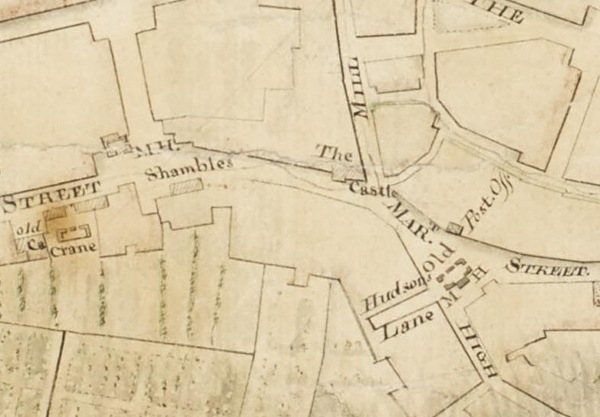
The 18th century saw the rise of three prominent market houses that shaped Newry’s civic and social landscape. The first, built between 1703 and 1737, was gifted a clock by Mr. Nedham and appears on Rocque’s 1760 map as the ‘Old Market House’ near Market Street. Despite its age, it remained a vibrant venue for auctions, meetings, and community events. Notices from the period highlight activities such as Patrick McKiben’s dancing lessons (1765), sales by James Maxwell (1766), and meetings of the Dundalk–Banbridge Turnpike Trustees (1756, 1766). In 1767, merchants and traders gathered there to discuss affairs related to the Newry Canal. The building was eventually demolished around 1785.

The second market house, constructed in 1750 on Boat Street (later Castle Street), featured a ground-floor market and an upper assembly room. By 1758, it had become Newry’s stagecoach departure point. The assembly room hosted political and social events, including a celebration of the Glorious Revolution (1764) and a banquet marking Admiral Keppel’s acquittal (1779). It also served as the meeting place for the Amicable Annuity Company (1778–1780), while the Newry Volunteers drilled on the ground floor. In later years, it functioned as a polling station for both Irish and British parliamentary elections.
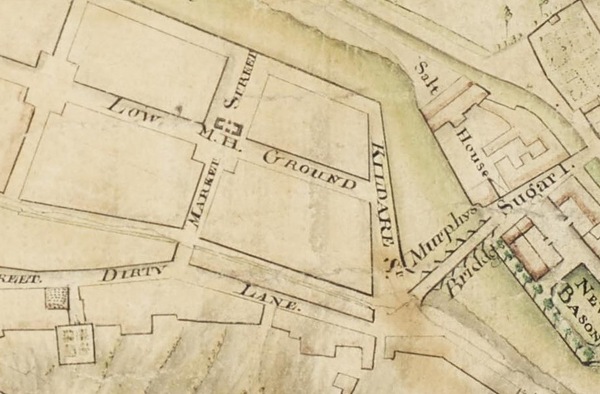
The third, known as Liberty Market House, was founded in December 1752 in the Low Ground, funded by the Earl of Hillsborough and local subscriptions. Intended as a yarn and linen market, it evolved into a lively social venue. It hosted cockfights (1765), dance nights (1766), New Year’s celebrations with country dances and theatrical performances (1767), summer balls (1768), and musical evenings (1769). By the 1770s, it also accommodated civic and military gatherings, including drills by the Newry Volunteers and the Newry Fusiliers.
From the 16th-century market cross to the trio of 18th-century market houses, Newry’s public spaces have long served as vital centres of trade, culture, and civic engagement, reflecting the town’s enduring spirit of community and enterprise.
Newry and Mourne Museum is open to the public seven days a week with admission free of charge. For opening hours, information on events and exhibitions, other services and bookings please phone 028 3031 3178 or visit www.visitmournemountains.co.uk
Write a comment
In the year that commemorated the 80th anniversary of the end of the Second World War, Remembrance Day will provide a time to reflect on the contributions made by local people to the war effort.
Planning had already begun before war was declared. A notice in the Newry Reporter on the 26 August 1939 signalled the urgent need for Air Raid Precautions (ARP) volunteers, such as wardens, rescuers, first aiders, auxiliary fire fighters and reporters. ARP wardens ensured the blackout, which came into effect on 1 September 1939, was maintained. In the event that the town would come under attack from the Luftwaffe, 27 air raid shelters were built around the town, each with a capacity for around 60 people, and a warning siren was installed on the top of Newry Town Hall.
The Women’s Voluntary Service (WVS) organised the distribution of gas masks, with a reported 52,000 required for the region. They assisted in the evacuation of children from Belfast, and organised educational classes to help cope with rationing. Coupons were issued for food, fuel and clothes and women running households had to become ever more resourceful.
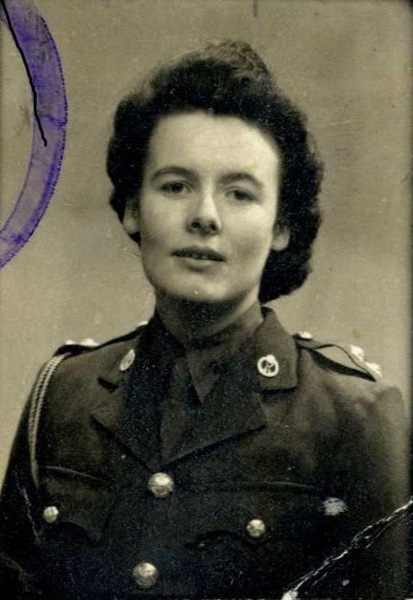
Local women, such as Lady Hyacinth Needham joined the military effort through the Women’s Royal Navy and Peggy Hall enlisted in the Women’s Auxiliary Air Force. Many other women served as nurses such as Margaret Anderson and Nora Mahood.

Many men joined the armed forces - an army recruitment office was located at 97 Canal Street and local newspapers encouraged enlistment and recruitment rallies were held for local regiments. The area became temporary home to other regiments of the British Army and the United States Army. Stationed throughout the district, they practiced manoeuvres in the local countryside, prior to posting in England or abroad.
Many were wounded or killed during the conflict. Cyril Wiltshire, originally from Wales and a member of the Welch Regiment stationed in the town, married a local girl and lived in Castle Street in Newry. He was killed on 21st July 1944 when his battalion came under heavy attack from German forces in Normandy.

Michael Flood Blaney, the son of the town surveyor Charles Blaney, joined the Royal Engineers Bomb Disposal Unit on 5 December 1940. He was killed a few days later when defusing a bomb at Manor Park in Essex. He was posthumously awarded the George Cross in 1941.
Others lost their lives at sea, such as Royal Navy Petty Officer John Felix O’Connell from Camlough. He was among the 1,415 men who died when HMS Hood was sunk in the Battle of the Denmark Strait on 24 May 1941 - the greatest single shipping loss of the war.
Some locals participated in key moments of the war. Robert Caldwell, who lived in Cowan Street, Newry, was a crewmember of HMS Exeter, which was in the Battle of the River Plate, off the coast of Uruguay in December 1939 when the German battleship, Graf Spee, was destroyed. Caldwell was welcomed as a ‘local hero’ when he returned home on leave in March 1940 and was awarded a gold watch by the Young Men’s Institute in Newry.
Bernard Murphy, Chief Engineer, and Terry O’Hanlon, First Mate, were crewmembers of the Dorrien Rose, a tramp steamer, which made three trips across the English Channel during the evacuation of Allied Troops from Dunkirk in June 1940. They rescued 1,600 men before the ship’s boilers gave up. Newry architect and engineer, Major Gerald Reside, serving with the British Expeditionary Force, was one of the last soldiers to be evacuated. Merchant ships were also under threat of attack. In October 1941, Bernard Golding from Erskine Street in Newry was lost when the SS Walnut, owned by Joseph Fisher and Sons in Newry, went missing in the Irish Sea.
Miles McCann, son of Matthew McCann, owner of the Victoria Bakery, joined the RAF Volunteer Reserve as an aircraftman in 1940 at the age of 18. He was posted to the Far East and was taken prisoner in February 1942 at the fall of Singapore. He was held as a Japanese prisoner of war in Malaya before being released in September 1945.
The Second World War was experienced on both a global and local level by the citizens of Newry and Mourne. From the home front to serving abroad, many local families have their own stories to tell of the sacrifices made and experiences of living through the most destructive global conflict in history.
Newry and Mourne Museum is open Tuesday to Saturday, from 10.00am to 4.30pm. Free tours of the main galleries are available on Wednesdays at 2.00pm. To book a tour, call 0330 137 4422 or email museums@nmandd.org for further information, or visit their website at www.visitmournemountains.co.uk
Write a comment
By the mid-18th century, Newry had transformed from a modest settlement into one of Ireland’s most dynamic mercantile and maritime centres. Its strategic position on the main Dublin to Belfast road and the opening of the Newry Canal in 1742 created a vital trade artery linking mid-Ulster to the Irish Sea and, beyond that, to the Atlantic and the New World. Within a century, Newry stood at the heart of a global trading network.
MacCabe’s Directory of Newry, Warrenpoint and Rosstrevor (1830) described Newry as “the most opulent and commercial town in the county,” boasting wealthy merchants and traders who thrived on its navigable connections to Lough Neagh, Belfast, and the Irish Sea. By 1850, Newry ranked as the fourth busiest port in Ireland.
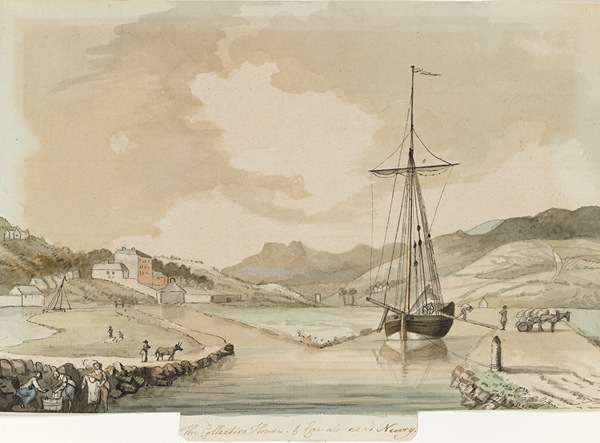
Exports from Armagh, Down, Monaghan and Louth flowed through Newry to destinations as far afield as North America, the West Indies, the Baltic, the Mediterranean and the Middle East. In return, the town became a marketplace for coal, timber, minerals, and exotic imports - spices, dyes, tea, and luxury goods - stocked in warehouses along Sugar Island and Merchants’ Quay. Many of these imported commodities such as sugar, coffee, and tobacco were produced by enslaved labour, while exports of butter, meat, and linen sustained enslaved people and plantation owners in the Caribbean and the Americas, a stark reminder that Newry’s prosperity was deeply entangled with the exploitation underpinning global trade.
The canal’s success spurred a wave of industrial growth. Tanning, ironworking, glassmaking, distilling, milling and shipbuilding flourished. The Richardson family’s linen mill at Bessbrook, established in the 1840s, exported globally through Newry’s port. Hill Street bustled with retailers catering to an emerging middle class, while the wealthy merchant elite furnished their homes with fine furniture and clocks crafted by local artisans such as John Gelston, and publishing and printing houses emerged to meet the growing appetite for education and culture.
Francis Carvill epitomised the entrepreneurial spirit of the era. Beginning as an ironmonger in 1824, he expanded into timber, slate, milling and spade manufacturing, operating from Merchants’ Quay and Sugar Island. Carvill became one of Newry’s most influential traders and later an emigration agent, arranging transatlantic voyages during the Great Famine.

For merchants, Newry’s rise meant wealth and influence; for their employees, security and choice. Yet many remained in poverty. The Great Famine of the 1840s drove thousands to emigrate, with ships departing for Philadelphia and New Brunswick. Social challenges accompanied prosperity - local newspapers reported rising crime and disorder, including cases of violence, drunkenness and prostitution.
By the 20th century, Newry’s prominence waned. Larger ships, global conflicts, and industrial decline reduced canal traffic, and the last vessel left in 1974. Warrenpoint Port adapted to modern shipping needs and continues to thrive, but the era of Newry as a global trading hub belongs to history.
From a single jetty in 1700 to a bustling port and industrial powerhouse by 1850, Newry’s story is one of ambition, resilience and transformation - a city that once connected Ulster to the world.
The new exhibition Making Waves: Newry’s rise as a global trade centre continues at Newry & Mourne Museum until September 2026.
The Museum is currently offering free tours of the main exhibition galleries on Wednesdays at 2.00 pm. These must be booked in advance by calling their Education Officer at 0330 137 4422.
Newry and Mourne Museum is open Tuesday – Saturday 10.00 am – 4.30 pm. Please call 0330 137 4422 or email museums@nmandd.org for further information.
Please visit their website at www.visitmournemountains.co.uk
Write a comment
Our Ship lies at Warrenpoint to Boston we set sail.
I wish her softly o'er the foam with a sweet and pleasant gale.
Had I a hundred pounds in gold or had I ten times more
I'd leave it all with Mary Bán, The Maid of Mourne Shore
Recounted by Jack Crawford, Warrenpoint, who remembered it being 'trolled' at Greencastle Fair. Reproduced from Cuisle na Ngael,1994
The Newry Ship Canal, as we know it today, is the result of centuries of engineering evolution. Its origins trace back to 1769, when the first ship canal was opened, connecting to the sea at Upper Fathom via the Fortescue Lock. This lock accommodated vessels up to 120 feet in length and with a draught of approximately 9 feet. Ships navigated inland to the heart of Newry, where the canal joined the earlier Inland Canal, constructed in 1742.

Larger vessels, unable to pass through the lock, discharged cargo at Warrenpoint. This port was developed in the 1770s with a dry dock and piers, funded in part by a £500 public grant – almost £50,000 today - and constructed by Roger Hall, Robert Rose, and Isaac Corry. However, by the early 1800s, the canal’s limitations and persistent silting at the lock entrance began to hinder Newry’s maritime trade and economic growth.
To address these challenges, two major improvement schemes were undertaken between 1830 and 1850. Extensive blasting and dredging deepened the channel at Narrow Water, including the removal of Nun’s Island, a historic religious site. Between 1842 and 1850, the canal was widened, deepened, and extended by 1.5 miles to Lower Fathom, where the new Victoria Lock was built. Named in honour of Queen Victoria, this lock could accommodate vessels up to 205 feet long and 50 feet wide. The town’s harbour was also expanded with the construction of the Albert Basin - at the time, the second-largest floating dock in Europe.
During the Great Irish Famine, Warrenpoint became a departure point for emigrants fleeing hardship. Over 5,000 people are estimated to have left from this port. One tragic voyage was that of the Hanna, which departed in April 1849 and was lost to an iceberg, claiming over 40 lives.
Many of the vessels were registered and operated by Newry-based shipowners. Among them was Francis Carville, who planned a direct voyage from Newry to New York aboard the New Zealand in April 1850. Although passengers were to embark at the Albert Basin, Carville ultimately relocated the embarkation to Warrenpoint due to insufficient water levels in the canal—a limitation that persisted as ship sizes increased throughout the 19th century.

Despite these constraints, Newry remained a hub of maritime activity. Cargoes arrived from America, Scandinavia, Russia, and across Europe. A fleet of steamships emerged, including the Newry, operated by the Newry Steam Packet Company. This company merged in 1871 with the Dundalk and Newry Steam Packet Company, which commissioned several Newry registered vessels such as the Bessbrook (1877), Iveagh (1892), and Dundalk (1918). The latter was tragically torpedoed in the Irish Sea during World War I, resulting in 20 fatalities. The company was later absorbed by B&I in the 1920s, with its final vessel, the Iveagh, scrapped in 1930.
By Sean Patterson
Discover more about the lives of residents in the port of Newry in the new exhibition Making Waves: Newry’s rise as a global trade centre which continues at Newry & Mourne Museum until September 2026.
The Museum is currently offering free tours of the main exhibition galleries on Wednesdays at 2.00 pm. These must be booked in advance by calling the Education Officer at 0330 137 4422.
Newry and Mourne Museum is open Tuesday – Saturday 10.00 am – 4.30 pm. Please call 0330 137 4422 or email museums@nmandd.org for further information.
Visit their website at www.visitmournemountains.co.uk
Write a comment
Coal importation was central to Newry’s maritime economy. Joseph Fisher founded his business in 1852, acquiring his first vessel in 1867. His son Frank expanded the fleet into one of Britain and Ireland’s leading steam collier operations. By 1940, Fisher’s of Newry operated fifteen ships, many named after trees such as Pine, Upas, Opepe, Karri. Though absorbed into Cawood Holdings in 1966, the company continued under Fisher family management.
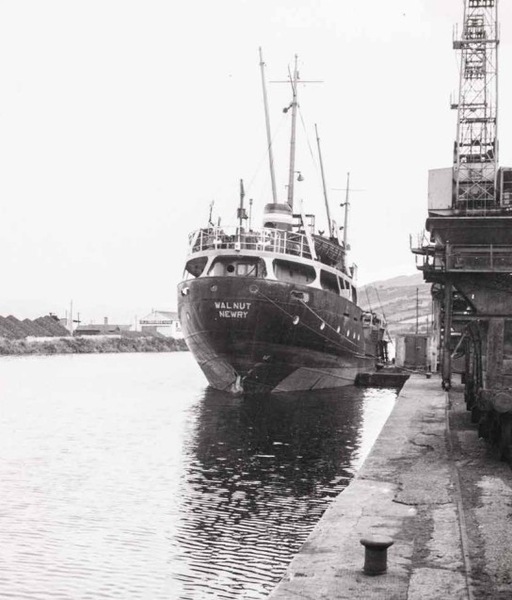
The Clanrye Steam Ship Company, linked to the Newry Provincial Coal Company, ran vessels such as Kilbroney, Killeavey, Speedy, Lady Belle, and Retriever before bankruptcy in 1924. Its last ship, Moygannon, was acquired by Fisher’s.
Life aboard was harsh: open bridges, dim engine rooms, cramped quarters lit by paraffin lamps, and straw-filled mattresses known as “Donkey’s Breakfasts.” Seamen often dried out above the boiler on a grating called the “fiddley,” as recalled by veteran Dan Brennan.
Between 1900 and 1942, eighteen Newry-registered colliers were lost. Some, like Kilbroney, sank on their maiden voyage; others, including Clonallon, Orior, Privet, and Walnut, vanished without trace. The worst disaster struck on 3 November 1916 when the Retriever collided with the passenger steamer Connemara near Cranfield Point. Both sank within minutes; of over ninety aboard, only James Boyle of the Retriever survived.
By the late 1940s, the Albert Basin bustled: Fishers’ colliers discharged coal while the M.V. Dundalk loaded livestock for Liverpool. Coal unloading was labour-intensive - dockers shovelled coal into tubs hoisted by derricks. A skilled gang could discharge 400 tons in eight hours. The 1950s brought change: steamers gave way to larger motor vessels, and in 1953, cranes replaced manual labour. By the 1960s, port employment declined, though Newry remained active.

Modernisation followed. Container traffic arrived aboard vessels like Wirral Coast and Noagh. During summer months, brightly painted Dutch coasters arrived with timber from the Baltic, adding a continental flair to the quayside. Gardner’s of Glasgow even commissioned canal-sized ships. But in 1968, disaster struck when the Saint William destroyed Victoria Lock’s seaward gates, trapping vessels. Soon after, operations shifted to Warrenpoint, which could handle larger ships. Kelly’s of Belfast sold the port to Warrenpoint Harbour Authority in 1971. By then, Warrenpoint and Newry handled half a million tonnes annually; today, Warrenpoint handles five times that.
The end came quietly. In March 1974, the Dutch tanker Anna Broere became the last commercial vessel to leave Newry. The final Newry-registered collier, Olive, was sold in 1981 and sank in the Caribbean in 1984.
For years, the canal faced uncertainty; proposals ranged from filling it in to turning it into a car park. Thanks to campaigners like Rowan Hand, John Donnelly, and John Fisher, Victoria Lock was restored, and the canal’s leisure potential revived. Highlights included the M.V. Balmoral’s visit in 1994 for Newry 850, the Asgard II in 1997, and the floating theatre M.V. Fitzcarraldo in 2000. That same year, nearly thirty sailing vessels arrived for “Folk Boat Week.”
By then, the Albert Basin had transformed. Coal yards gave way to The Quays retail complex, its logo - a sailing vessel - honouring Newry’s maritime heritage and spirit of reinvention.
By Sean Patterson
Discover more about the lives of residents in the port of Newry in the new exhibition Making Waves: Newry’s rise as a global trade centre which continues at Newry & Mourne Museum until September 2026.
The Museum is currently offering free tours of the main exhibition galleries on Wednesdays at 2.00 pm. These must be booked in advance by calling their Education Officer at 0330 137 4422.
Newry and Mourne Museum is open Tuesday – Saturday 10.00 am – 4.30 pm. Please call 0330 137 4422 or email museums@nmandd.org for further information.
You can visit their website at www.visitmournemountains.co.uk
Write a comment
As Christmas approaches, thoughts turn to festive traditions and the toys topping children’s letters to Santa. To celebrate the season, Newry & Mourne Museum has unveiled a nostalgic display of toys from times gone by - each with its own story to tell.
Did you ever play Buckaroo? The classic game where players carefully stack items on a spring-loaded mule without making it buck? If so, do you remember the mule’s colour? On show is an original 1970 edition featuring a white mule - later versions switched to a brown bucking bronco!

Another highlight is the Magic Robot quiz game from the 1950s, produced by Merit (J&L Randall Ltd). This ingenious educational toy used a hidden magnetic mechanism to make the robot point to the correct answers, a clever nod to the robot craze sweeping popular culture at the time. Speaking of robots, the Museum also boasts a rare example of the first Dalek toy, made by Louis Marx & Co in 1965. This friction-drive model was inspired by the BBC’s Doctor Who serial “The Daleks” (1963), which sparked the phenomenon known as “Dalekmania.”
Continuing the sci-fi theme, visitors can marvel at the Flashy Flickers Gun featuring The Phantom, also produced by Louis Marx in 1965. Shaped like a machine gun, this battery-powered projector displayed images from a film roll loaded at the top, an early fusion of toys and technology.

The display also reaches back to the 1890s with a bisque-headed musical marotte doll. These curious, disembodied heads mounted on sticks trace their origins to the jester’s staff. By the 18th and 19th centuries, marottes had evolved into musical amusements for adults and children, often carried at masked balls as whimsical “party fancies.”
Fast-forward to the swinging ’60s and you’ll find a Sindy doll, alongside a cheeky clone cashing in on her popularity - proof that counterfeit goods are nothing new! Homemade treasures also feature, including a charming toy piano and a Humpty Dumpty doll from the 1970s, possibly inspired by the beloved character from BBC’s Play School.
Bringing us closer to the modern era, the 1980s section showcases tech-driven favourites like Speak & Maths, an electronic learning toy by Texas Instruments, and a Nintendo Game & Watch handheld console. This portable device adapted the arcade hit Donkey Kong and introduced the four-way directional pad - a design that revolutionised gaming.
And for a festive twist, keep an eye out for our seasonal trail throughout the museum galleries. Some mischievous toys have escaped! Can you and your family find them all?
The Museum is currently offering free tours of the main exhibition galleries on Wednesdays at 2.00 pm. These must be booked in advance by calling the Education Officer at 0330 137 4422.
Newry and Mourne Museum is open Tuesday – Saturday 10.00 am – 4.30 pm. Please call 0330 137 4422 or email museums@nmandd.org for further information.
Visit their website at www.visitmournemountains.co.uk
Write a comment
Newry Maritime Association has received the donation of three incredible models of Newry connected ships from a Lisburn model maker, and today they found a new home when they went on display at Newry Library.
John McAleavey, 82 has spent over forty years making models of ships and Newry Maritime Association were overjoyed to receive the generous gift of models of three ships that were owned by Newry based Joseph Fisher and Son's. The Ulidia, The Pine and The Portadown will be displayed in the heritage area of Newry Library.

For John the models can take about six weeks to make from a solid block of wood with wood cut to size for boat features. The level of detail is quite extraordinary.
John himself went to sea when he was 16 years old with Canadian Pacific Steamships on the Empress of England. Seafaring was certainly in the family, his grandfather worked on the Joseph Fisher and Son's ship, Portadown in 1914.
James McAreavy from Newry Maritime Association couldn't believe his eyes when he went to look at the models. "I was just totally taken aback when I saw the level of detail and the work that John had put into these models. I couldn't believe it and anybody that has seen them from we got them over a month ago, the first thing they comment on is the level of detail. Absolutely fantastic and a real credit to John. I really want to thank him for his very kind donation and also to thank Chris Cassidy, the heritage officer who readily agreed to have them here in the library on permanent loan."

"We've done a lot of work with Chris Cassidy. Chris is very much involved in the promotion of local history and has a great relationship with the community and voluntary sector here in Newry, and we're very fortunate to have him." he added.
Speaking of the Maritime Association James explained "We are a voluntary group that's given to the preservation and active promotion of the history of the Port of Newry, and very important to the history of the port is the firm of Joseph Fisher and Son's".
James gave a background story to the three ships depicted in the models explaining that every ship has a story. "It's very appropriate that we have them in Newry because they are so relevant to the port. Every ship has a story - The Portadown was built in 1900. One of the captains on the Portadown was a man called Patrick Leo McCourt, and he lived in Fisher's Row in Bridge Street. He was a lifetime Seaman, but he had a son of the same name, Patrick Leo McCourt, who was awarded the Distinguished Service Cross at Normandy, 1944 for heroism. He was the captain on a ship called the Wallace Rose, and he was involved in the move across the channel when two and a half million men were moved over to Normandy, and that was the beginning of the end of World War Two.

"Captain McCourt landed valuable equipment, and he held the line for four days under heavy German fire and withdrew safely, and he was awarded the Distinguished Service Cross." Tragically Captain McCourt was to lose his life on the Wallace Rose 10 years later in the Thames when a Swedish coaster collided with it in fog.
James continued "These ships here are 400/500 tonne capacity.The Ulidia was built in 1903 and she was nearly 5000 tonnes. She was built by John Redhead and Company in Souths Shields, and was deployed as a foreign going vessel in the Baltic, Mediterranean and journeys like that. Fisher sold her in 1916 and she went on to different owners, and eventually she was wrecked in 1948 after a career of 45 years." Because of its size it was the only ship that Fisher's had that never came to Newry.
Lastly James talked about The Pine. "The Pine was built in 1907 and it was deployed on the home trade around Britain and Ireland and at that time, Fishers done a lot of work in northwest Europe, for instance they used to take cargos of herrings from the Orkney Islands to Hamburg in Germany. They would have taken timber from the Baltic back to England, anything literally, that could be put into the hold of a ship Fishers would take it." he explained.
James explained that the Newry that we have today is built on the foundations and the prosperity that was generated from the port.
"The catalyst for the development of the port was the building of the Newry Canal in 1742, and that gave us a gateway literally to the world. Newry was a hub of global trade. We had mills, we had glass works, we had tannery's, distilleries and along with that the canal increased Newry's hinterland. Where a horse and cart could move three or four tonnes a day, once the canal was opened we had a hinterland that took us into mid Ulster and then when you got to Lough Neagh, It was like a motorway service area - you had the River Bann in front, You'd the Lagan Canal to the right and the Ulster Canal to the left. We had raw materials going out, finished goods coming back, merchants added value to it and Newry became a hub of global trade" he said
Joseph Fisher established the business in 1852 and they traded in Newry for the next 110 years. James added "Many, many families, including my mother's own family, was reared on the money that was generated from the wage packets, either at sea or landslide."
Write a comment
As the year draws to a close, communities across Ireland prepare to mark one of the most ancient events in the calendar, the winter solstice. For thousands of years, this turning point has symbolized hope and renewal and nowhere is its legacy more visible than at the summit of Slieve Gullion, where an extraordinary passage tomb connects us to the beliefs and ingenuity of our earliest ancestors.
On 21 December, the shortest day of the year, the winter solstice held special significance for the Neolithic people who lived here between 4000 and 2500 BC. Known as "Grianstad an Gheimhridh" in Irish Gaelic (literally, winter sun stop), this celestial event was revered by the Celts as a pivotal moment symbolising the triumph of light over darkness, signalling the gradual lengthening of days and the promise of renewed life in the coming year.

The region’s first farmers transformed the landscape and left behind remarkable evidence of their lives. Among their most enduring achievements are the megalithic tombs, including the passage tomb crowning Slieve Gullion. Estimated to be 5,000 years old, this structure is the highest surviving tomb of its kind in Northern Ireland, perched at an altitude of 570 metres. Its design is extraordinary: a burial chamber within a circular mound, accessed by a narrow passage. This passage was carefully aligned so that, on the winter solstice, the setting sun illuminates the back of the chamber, providing powerful evidence of how early communities understood and celebrated the cycles of nature.
Slieve Gullion is not only an archaeological treasure but also a place steeped in legend. One famous tale tells of Cailleach Beara, a witch who transformed herself into a hare, who tricked the giant Finn McCool into bathing in the mountain’s lake. Finn emerged aged and withered, and although his youth was restored, his hair remained white for the rest of his life.
The tomb suffered damage in 1892, when Fr Luke “Red” Donnellan used dynamite in an attempt to excavate it. Despite this, enough remains to show its impressive scale and craftsmanship, marking it as one of Ireland’s major passage graves.
In 1961, archaeologists from Queen’s University Belfast undertook a formal excavation. Working in challenging conditions, they established a camp below the summit and relied on local farmers Joseph Hughes and Sean O’Grady who, at great risk, carried their equipment almost to the summit in his tractor. Their findings revealed a chamber 3.66 metres wide, with a roof reaching 4.3 metres high, and an outer mound measuring 30 metres in diameter. They also uncovered two large stone basins inside the passage, likely used in burial rituals.

Today, visitors can explore this heritage further at Newry and Mourne Museum, which houses an extensive collection of Neolithic artefacts. These include tools and pottery that shed light on daily life thousands of years ago. Among the highlights are a mano stone tool from Carnbane, uncovered during a 2011 excavation, which was used for grinding grain and seeds for food, and a flint blade for scraping animal hides. Shards of pottery, fragments of an arrowhead, scrapers, and blades were also found at the site. Another remarkable piece is a porcellanite axe dating to around 4500 BC, discovered near Dundrum, which was used for cutting trees and for trade. A lozenge-shaped javelin head found near Leitrim, County Down, illustrates the hunting practices of late Neolithic farmers.
These artefacts reveal a story of resilience and ingenuity, rooted in a deep connection to the land and changing seasons, which is marked each winter solstice when sunlight unfailingly reaches the heart of Slieve Gullion’s tomb. (15/12/25 Note - Unfortunately the Slieve Gullion Passage Tomb is currently closed and will remain closed over the 2025 winter solstice.)
The Museum is currently offering free tours of the main exhibition galleries on Wednesdays at 2.00 pm. These must be booked in advance by calling our Education Officer at 0330 137 4422.
Newry and Mourne Museum is open Tuesday – Saturday 10.00 am – 4.30 pm. Please call 0330 137 4422 or email museums@nmandd.org for further information.
Visit their website at www.visitmournemountains.co.uk
Write a comment
While Halloween is usually the time of year many would associate with stories and encounters of the supernatural, Christmas was also well known for its share of ghost stories especially during the Victorian period. With candles or a fire being the only source of light, the atmosphere helped create an ideal setting for ghost stories. The most famous of Christmas ghost stories was the Dicken’s classic “A Christmas Carol” published in 1843. In keeping with the season, Newry and Mourne Museum has decided to share some of the local Christmas ghost stories found in a booklet entitled “Christmas Stories from Old Newry and Mourne” from its collection.

The first tale in the booklet speaks of an auctioneer, who was visiting his half-cousin, Hugh Sinclair, in Rostrevor. After a long night of fishing the men were walking in the dark through a tunnel of trees when they encountered a wailing old woman carrying a heavy load on her back. As the lady approached them, they realised she was carrying the body of a man. The men followed the woman through the tunnel of trees however when she reached the light of a lamppost she disappeared. It was believed to have been the ghost of an 80-year-old woman who had gone to collect the body of her son who that been killed at the Battle of Bloody Bridge. She had disguised his body and had intended to carry him back for a burial, using the routes through the trees to avoid detection, however, the strain of her journey was too much, and both their bodies were found just outside the churchyard at Kilbroney. What made the story more compelling was that prior to seeing the ghost, the auctioneer had recently purchased a sword for auction that he believed to have belonged to the fallen man and therefore thinks he had been haunted by the ghost of the man and his mother as they made their way home.
Much like “A Christmas Carol”, the next story involves themes of redemption and issues of morality. The story is in the form of a short poem detailing the exploits of the Ghost of Edenmore, a man named Eamon Roe MacGrann who died one winter night at the age of twenty-eight. His ghost came back every market night to steal the wares of any traveller crossing his path. The poem describes his defeat at the hands of O’Neill of Eight-Mile Bridge who made him return any gold he stole before vowing to never rob the living again. After swearing to honour the man who bested him, the ghost disappeared and was never seen again.

Some of these supernatural events have a way of connecting people to their new community.
The last story in the book talks of a man who took a job at the Silent Valley at the beginning of the reservoir work, learning all about the Bingian Light, a mysterious light that travels around the valley, playing tricks on unsuspecting individuals by chasing ladies travelling alone or confusing men by appearing as a cat or monkey riding a bike. During the Christmas season the man would have his own experience with the light as he travelled towards a funeral. The light charged at him while he was travelling by bicycle. Frightened, the man planned to avoid the same route on the way home only to encounter the light again. The man would go on to say the light, encouraged by its reception would randomly appear while the man was travelling in the area, appearing so often that he no longer feared the sight of the light and embraced the visits while he lived there.
For those who love scary stories, on the 29th January the Museum is hosting a talk on real-life fiends William Burke and William Hare (who was born and worked in Newry). Historian Andrew Johnston of Alternative Ulstours brings his Edinburgh Festival Fringe sell-out talk “Burke and Hare: Body Snatchers, Serial Killers, Ulstermen” to the Museum for the first time. Contact the Museum for further details.
The Museum is currently offering free tours of the main exhibition galleries on Wednesdays at 2.00 pm. These must be booked in advance by calling our Education Officer at 0330 137 4422.
Newry and Mourne Museum is open Tuesday – Saturday 10.00 am – 4.30 pm. Please call 0330 137 4422 or email museums@nmandd.org for further information.
Please visit their website at www.visitmournemountains.co.uk




 |
 |
 |