

 Write a comment
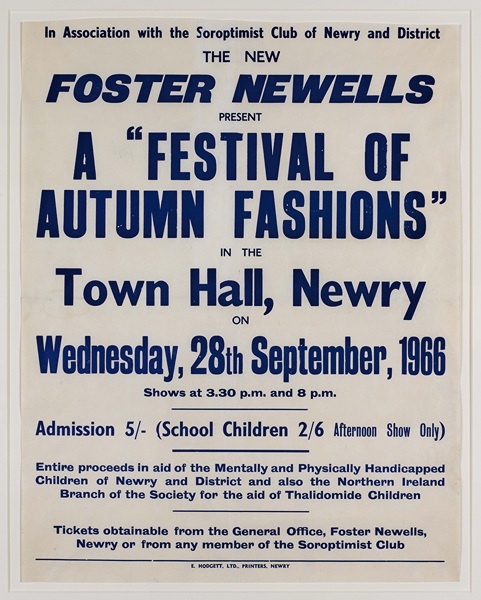
Women have long shaped charitable life in Newry, their work woven through the town’s history in acts of care, education, and community leadership. That legacy was further affirmed last year when the Newry Inner Wheel donated its archive of photographs, records, and press material to Newry & Mourne Museum which is a remarkable record of decades of women-led voluntary activity.
Organised women’s charity in Newry stretches back almost two centuries. In the early 1800s, religious communities were central to addressing poverty. Sr Michael (Mary Tracey) of the Sisters of St Clare helped found Newry’s first convent in 1830, and the community became an essential source of support during the Famine, providing food, clothing, medicine, and education. Their 1840 Work School offered girls muchneeded practical skills. The Sisters of Mercy continued this mission, opening a night school in 1865 for women and girls employed in Newry’s mills, providing training in sewing, lacemaking, literacy and numeracy.
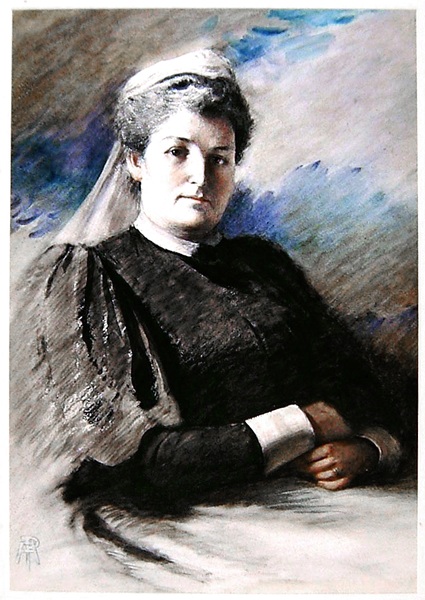
Aristocratic women also played significant roles in nineteenth and early twentieth century philanthropy. The Kilmorey family of Mourne Park was particularly notable. Ellen Constance (“Nellie”) Needham, Countess of Kilmorey (1858-1920), became a key figure in wartime relief as Commandant of the South Down Nursing Corps during the First World War, coordinating care for wounded soldiers of the Ulster Division. Her predecessor, Jane, Countess of Kilmorey (d. 1867), was remembered for her relief work during the Great Famine. Their involvement reflects how large estates acted as hubs of local welfare provision.
Middleclass women were no less engaged. By 1830, the Ladies Benevolent Society and the Ladies Benevolent Clothing Repository were already supporting the town’s poorest families. Newry’s international links broadened the scope of this work: in 1831, the “Ladies of Newry” sent handmade clothing, books, and dolls to Mrs Wilson in Calcutta for use in her native schools, an early example of global outreach driven by domestic skills and collective organisation.
Throughout the nineteenth century, women emerged as organisers of humanitarian initiatives, leading temperance efforts, managing parish charities, and supporting social reform. Figures such as Miss Perry, proprietor of the Temperance Hotel on Sugar Island in 1890, highlight how women built civic influence long before wider opportunities in professional or political life became available.
These traditions expanded in the twentieth century as fundraising committees became a familiar feature of community life. Groups such as the Newry Barnardo’s Committee raised substantial funds for children’s welfare. Among the most enduring organisations was the Inner Wheel, founded in 1924 and now one of the world’s largest voluntary movements for women. The Newry branch, established in 1948 and the third oldest in Ireland, has consistently embodied its core values of friendship, service, and international understanding. Its newly donated archive preserves this long record of civic engagement, often overlooked in mainstream histories.
The Soroptimist movement, founded in California in 1921, also became a major force in advancing women’s education and wellbeing. In Ireland, Soroptimist clubs offered women new opportunities for leadership and advocacy. The Newry Soroptimists were deeply involved in community development through fundraising, health initiatives, youth education, and collaboration with other voluntary groups at home and abroad, and their archive was generously donated to the Museum as well.
Women’s philanthropic leadership continues to thrive. On 28 February 2024, Women’s Aid Armagh Down marked its 40th anniversary with the “Be the Change” conference in Newry, highlighting the ongoing need for support and advocacy. Caring Coins Newry, founded in April 2020 by local women Kerrie Havern and Yvonne Campbell, offers another example of this living tradition. What began as a simple act of collecting spare change during the COVID19 pandemic has become a registered charity supporting local families and promoting mental health. These are just two examples of the many vibrant and dynamic philanthropic endeavours of women in the district.
Philanthropy has long provided women with meaningful public roles, particularly at times when access to employment, political participation, and economic independence was limited. Today, while women contribute across every sphere of civic and professional life, this history of voluntary action continues to underpin community wellbeing. In Newry and Mourne, as elsewhere, generations of women have shaped local society through commitment, compassion and collective effort.
The Museum is currently offering free tours of the main exhibition galleries on Wednesdays at 2.00 pm. These must be booked in advance by calling the Education Officer at 0330 137 4422.
Newry and Mourne Museum is open Tuesday to Saturday 10.00 am to 4.30 pm. Please call 0330 137 4422 or email museums@nmandd.org for further information.
You can visit their website at www.visitmournemountains.co.uk
Write a comment
In the late 18th and early 19th centuries the Marshall family farmed in the townlands of Tullymurry, Buskhill and Annaghbane, in Donaghmore, where they played an active role in parish life through the Donaghmore Farming Society and the local Vestry. In 1839, 24 year old Andrew Marshall left this familiar world behind and emigrated to America. His letters home describe the journey, the challenges he faced, and the opportunities he sought across the Atlantic.
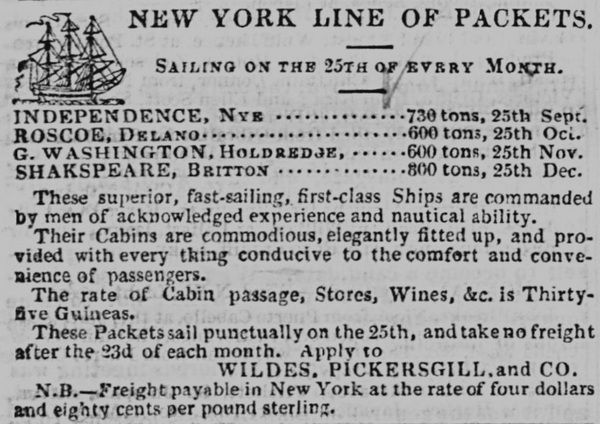
By the 1830s rising trade between Britain and the United States had brought down the cost of trans-Atlantic travel, making emigration more achievable for families like the Marshalls. Andrew travelled first from Newry to Dundalk and then onwards to Liverpool, where he boarded the packet ship George Washington. The vessel arrived in New York on 2 September 1839, after a voyage lasting 38 days. Packet ships such as the George Washington were built for speed and rough seas, carrying mail, cargo and passengers. Andrew reported comfortable accommodation and a crowded vessel that included 30 cabin passengers, 30 steerage passengers, a sizeable crew, and even a small menagerie of livestock.
The ship sailed north via the North Channel, giving passengers striking views of the coasts of Ireland and Scotland. But the beauty of the early voyage soon gave way to danger. On 7 August a violent storm struck, which Andrew described as “a real fourhour hurricane”. A blast of wind threw the ship on her side, water poured over the decks, and the sails were shredded. Women fainted, chains sparked in their casings “like a large fire”, and the crew worked through the night to regain control. By the next morning the storm had passed, leaving the deck littered with torn canvas, “like rags for a papermill”. Weather continued to delay them with days of calm, sudden shifts of wind, and encounters with porpoises, dolphins and sperm whales. Yet their passage proved faster than most that season, arriving a full eight to ten days ahead of other July packet ships.
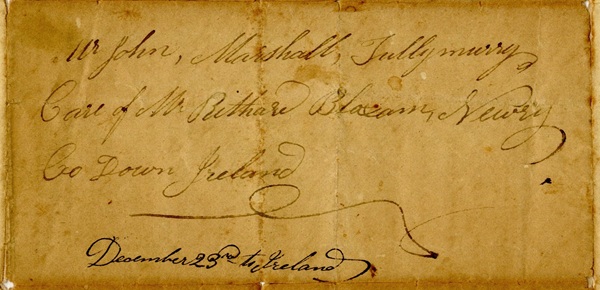
After a brief quarantine at Staten Island, Andrew set foot in New York, which he found astonishing in scale and prosperity: “Take 20 Newry’s put together, and they would be nothing to it.” He remarked on the absence of beggars and the independence of local farmers, who paid no rent or tithes and received good prices for produce. These observations hint strongly at the economic motivations behind his decision to emigrate. New York, however, was not without its troubles: numerous fires kept him awake at night to the sound of alarms. From the city he travelled north to Watertown, Jefferson County, a journey of 350 miles by steamboat, rail and stagecoach. The entire trip from Donaghmore to Watertown cost £8.14s.6d, roughly equivalent to £787 today.
Andrew’s early letters reveal the emotional challenges of settling abroad. He learned shortly after arriving that his sister Essy had died while he was at sea, and he struggled with the extremes of North American weather: intense summer heat, early snow, and a long “Indian summer”. He boarded with fellow migrants and quickly became part of a network of Irish settlers who kept each other informed through newspapers such as the Old Countryman. Locals were eager for Irish stories - some true, some not - and Andrew found himself fielding questions about a hoax involving a man “sleeping on his spade” in Lurgan. Watertown was still feeling the aftershocks of the recent Upper Canada Rebellion and Patriot War. Some rebels had been jailed locally for burning the Canadian steamship Sir Robert Peel, and Andrew observed that the border tensions were far from forgotten.
The final surviving letter is from Andrew’s sister Isabella in July 1845. By then Andrew had moved to Ontario, married Margaret Lowry, and started a family. Isabella planned to join him, seeking new prospects in Toronto. Her desire to emigrate was influenced by changes at home, her brother Joseph’s marriage and the knowledge that the family farm would eventually pass to him. It is not known whether Isabella completed the journey, but by 1851 Andrew, Margaret and their children were firmly established in Durham County, Ontario.
The Marshall letters offer a vivid personal account of pre-Famine emigration and the chain migration that encouraged families to follow one another abroad. Their story mirrors that of many local people recorded in the diaries of James Harshaw, who chronicled the steady outflow from Donaghmore to America in search of opportunity and independence.
Discover more about the lives of residents in the port of Newry in the exhibition Making Waves: Newry’s rise as a global trade centre which continues at Newry & Mourne Museum until September 2026.
The Museum is currently offering free tours of the main exhibition galleries on Wednesdays at 2.00 pm. These must be booked in advance by calling the Education Officer at 0330 137 4422.
Newry and Mourne Museum is open Tuesday – Saturday 10.00 am – 4.30 pm. Please call 0330 137 4422 or email museums@nmandd.org for further information.
Visit their website at www.visitmournegullionstrangford.com
Write a comment
Newry & Mourne Museum’s new exhibition, Categorically Celtic - traditional design in art, politics and popular culture, traces how Celtic-inspired symbols have shaped everyday life on this island, on banners and badges, church textiles and school certificates, record sleeves, and Irish dancing dresses. On show until September, it reveals how spirals, knots, shamrocks, harps and the Red Hand move across communities and centuries, carrying meanings that are shared, adapted and sometimes contested, yet always entwined.
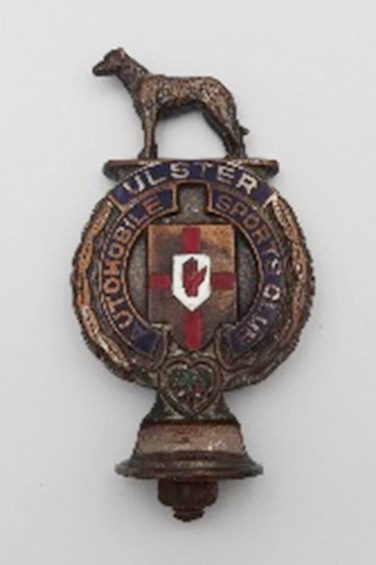
Celtic ornament has long been a visual shorthand for identity in Ireland. It surged again during the late 19th and early 20th century revival, when cultural groups and political movements used flowing interlace and bold triskeles to evoke heritage and hope. Yet these motifs never belonged to only one tradition. Visitors will see, for example, a Great Northern Railway (Ireland) company crest that brings together civic arms from across the island with the Red Hand of Ulster, a reminder that shared infrastructure and shared imagery linked people well before modern borders.
Religious devotion, design fashion, and national feeling often sit side by side. A delicate ciborium veil made in the Sisters of Mercy needlework school in Newry uses Carrickmacross lace to weave shamrocks into a sacred textile; nearby, St Brigid’s crosses from the Mournes and South Armagh show regional variations in a form that bridges the early spring festival of Imbolc and Christian storytelling about care and conversion.
The exhibition also explores how the same symbol can speak in very different voices. A Lambeg drum created for Queen Elizabeth II’s Golden Jubilee brings together the Red Hand, the shamrock, and flowers of the UK nations, showing a Unionist reading of Ulster identity. In another case, an Ancient Order of Hibernians sash brims with harps, shamrocks, a round tower and an Irish wolfhound, emblems of Catholic fraternal society, with similarities, in green, to the ceremonial styles of Orange tradition. Seen together, they demonstrate parallel languages of belonging built from a common alphabet of signs.
Celtic design has always adapted to new media. Handembroidered Irish dancing dresses from the 1970s, worn by champion dancers, reinterpret motifs from the Book of Kells in vivid colour and crochet; and a midcentury Irish dancing medal carries a harp and triskele. Across the gallery, visitors will encounter contemporary tattoo design from Triskele Tattoos of Castlewellan, proof that spirals and interlace remain fresh in 21stcentury creative practice.

Historical craftsmanship shines too. Replicas of the Tara Brooch by Dublin jeweller George Waterhouse tell a fascinating story: after the eighth century original was found near Bettystown in 1850, Waterhouse cleverly branded it the “Tara” brooch, linking his replicas to the High Kings to ignite public imagination. That 19th century marketing helped cement the brooch as an icon of Celtic design, cherished by people across the world.
A matchstick round tower made by a Newry man while interned in the Curragh Camp during the 1950s evokes endurance and memory through an iconic early medieval form, while a model harp made by a female prisoner in Armagh Gaol speaks to protest and identity in the language of tradition. These sit alongside Art Ó Murnaghan’s preparatory drawings for the monumental, unfinished Leabhar na hAiséirghe (Book of the Resurrection), conceived to illuminate sacrifice and nationhood.
Education and everyday life are part of the picture. A 1920 Higher Grade Certificate wraps a child’s academic achievement in interlace; Irish language badges (fáinní) signal fluency and pride; an Irish copy book from the Gaelic League and an early grammar by the Dundalk Presbyterian minister William Neilson (who preached in Irish in Newry) show how language revival and crosscommunity scholarship intertwined.
Women artists and makers also take centre stage. The exhibition features bookends from Cluna Studio, founded by Portadown’s Gertrude Grew, who reimagined Celtic forms in modern craft; and works by local makers Loretta Gallagher and Frances Bauer feature ogham lettering, spirals, and traditional symbols in contemporary craft.
What emerges is a richly layered portrait: Celtic design is a living language. It speaks in church and lodge, on sports fields and dance floors, in classrooms and concerts, in Unionist parades and Nationalist commemorations. The same harp or spiral can mean home, faith, resistance, welcome, memory or celebration, depending on who is looking, and when. Categorically Celtic invites you to look closely at the craftsmanship, to learn the stories behind familiar signs, and to appreciate how symbols connect people across difference.
Visit before September to experience this conversation across time and tradition and to find your own thread in the knotwork. Newry & Mourne Museum welcomes individuals, families, schools, and community groups; keep an eye on social media for talks and activities linked to the exhibition. On St Patrick’s Day, visitors can join a free bi-lingual tour of the exhibition, in English and Irish, as well as crafts and activities for families of all ages.
The Museum is currently offering free tours of the main exhibition galleries on Wednesdays at 2.00 pm. These must be booked in advance by calling our Education Officer at 0330 137 4422.
Newry and Mourne Museum is open Tuesday – Saturday 10.00 am – 4.30 pm. Please call 0330 137 4422 or email museums@nmandd.org for further information.
Visit their website at www.visitmournegullionstrangford.com
Write a comment
This week, Newry and Mourne Museum is looking back at one of the town’s most storied enterprises: the Matt D’Arcy and Co. distillery, a business that helped shape Newry’s industrial identity for more than a century.
The company’s roots stretch back to 1817, when a young Matthew D’Arcy, just twenty-six, went into partnership with Denis Caulfield and Robert Thompson. D’Arcy had recently inherited property and money from his late father, while Thompson brought solid experience in distilling and Caulfield contributed wealth earned through trading and cattle breeding. A few years earlier, in 1815, Caulfield had purchased a distillery originally built by Samuel Hanna in 1780 on what we now know as Monaghan Street. This site would become the heart of the future Matt D’Arcy empire.

After Caulfield’s death in 1819, his nephew Denis Caulfield Maguire joined the partnership. The trio were well positioned for success: Maguire’s milling business sat close to the distillery, and the partners owned extensive barley fields - an ideal recipe for a booming whiskey trade.
By 1823, D’Arcy and Thompson expanded operations to Belturbet, Co. Cavan, but the venture soon faced turbulence. In 1826 four employees were brought to court for obstructing a Post-boy in Co Cavan, and only months later a fire swept through the Belturbet distillery backhouse. More serious still was the discovery that Thompson owed £20,000 in unpaid duty from 1816, when drought and mechanical breakdown had halted production. The debt forced Thompson into bankruptcy, and by 1831 Belturbet’s equipment was up for sale, signalling the end of whiskey-making there.
Back in Newry, the story took a new turn with the death of Matthew D’Arcy. His nephew Thomas D’Arcy Hoey, then just twentyfour, assumed control. Over the next three decades he reshaped the business, modernising facilities and boosting output. Hoey had the old chimney, another of Samuel Hanna’s legacies, demolished to make way for an enormous twostorey, 20,000squarefoot warehouse. He also commissioned celebrated architect W.J. Barre, renowned for Belfast’s Ulster Hall and the Albert Clock, to design an impressive façade for the distillery.
Hoey wasn’t the only one to call on Barre’s talents. His business rival Henry Thompson, nephew of D’Arcy’s former partner, also hired Barre to create a striking front for his buildings at Trevor Hill. Despite their competitive streak, the two men worked together when it counted, jointly holding shares in the Newry Navigation Company and backing bold plans for a 61mile tramway from Rathfriland to Co. Tyrone.

Although the original distillery eventually ceased operations, the Matt D’Arcy name has never been forgotten. In 2020, the brand was revived by local businessman and historian Michael McKeown, and today its whiskey is produced in partnership with Echlinville Distillery, ensuring that one of Newry’s most iconic names continues to raise a glass to the future.
The Museum is currently offering free tours of the main exhibition galleries on Wednesdays at 2.00 pm. These must be booked in advance by calling our Education Officer at 0330 137 4422.
Newry and Mourne Museum is open Tuesday – Saturday 10.00 am – 4.30 pm. Please call 0330 137 4422 or email museums@nmandd.org for further information.
Visit their website at www.visitmournegullionstrangford.com
Write a comment
Newry and Mourne Museum has opened a new temporary exhibition entitled ‘Categorically Celtic - Traditional Design in Irish Art, Politics and Popular Culture,’ which explores the significance of Celtic art within Irish life, tracing its evolution from its ancient origins to contemporary everyday use.
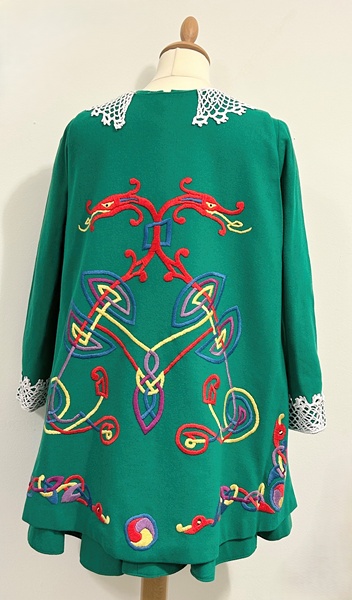
The exhibition maps the trajectory of the art-form from its Iron Age roots to the present, where we can see its influence in imagery such as sports branding, school logos, and even the modern resurgence of Celtic inspired tattoos.
The cultural prominence that these art forms enjoy today has not always been the norm. Throughout the 19th and 20th centuries, a series of influential organisations emerged with the mission of reviving Irish sport, literature, art, and especially language from decline.
Among the earliest were the Young Irelanders, who in the 1840s sought to intertwine political independence with a cultural awakening. By championing the study of Irish history and the revival of the Irish language, they established these traditions as the essential pillars of Irish nationality.
By the late 19th century, there was a greater urgency to revitalise the Irish language. The impact of the Famine on Irish society was devastating. In the 1841 census, the population of Ireland was approximately 8.2 million, but by 1851 this had decreased to 6.6 million. A vast number of those who died or emigrated were native speakers, which accelerated the language’s decline.
The Gaelic League (Conradh na Gaeilge), founded in 1893, was in many ways the vanguard of this revival. The core aims of the League were to fight against the erosion of Irish culture and sports and to reintroduce the language into schools, as the National School system taught only in English. The organisation was non-political and non-sectarian, aiming to involve people of different religious and political loyalties in a common cultural effort.
The Gaelic Literary Revival of the late 19th century, inspired by the Gaelic League sought to create and inspire a national literature by drawing on Irish myth, folklore, and popular culture. Some of the revival's most visible proponents and practitioners included William Butler Yeats, Lady Gregory, and John Millington Synge.
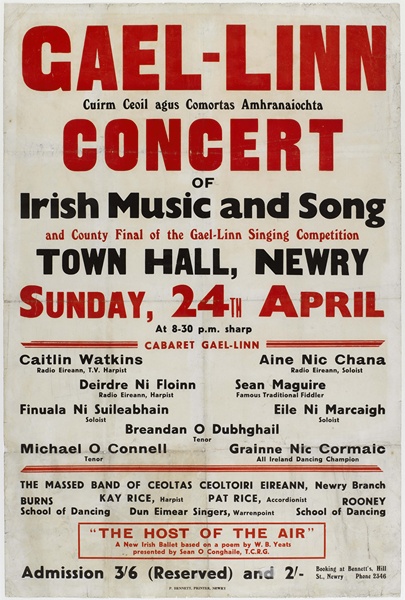
In 1882 Yeats together with John O’Leary and Douglas Hyde founded the National Literary Society which was aimed at publicising the literature, legends and folklore of Ireland. Also in the 1890s, he worked with Lady Gregory and Edward Martyn to establish a distinctively Irish national theatre, their efforts culminating in the Irish Literary Theatre (1898). The Abbey Theatre, established in 1904 with the support of Yeats, served as the nation’s first stage for Irish drama set against the growing cultural nationalist movement
Sport also played a vital role in cultural revival. The Gaelic Athletic Association, founded in Thurles on November 1, 1884, was set up to standardise the rules of Gaelic games such as hurling, but also to establish a body to govern Irish sports. The Association also promotes Irish music, song and dance and the Irish language as an integral part of its objectives. Today, there are in the region of 2,300 clubs based in Ireland.
It also continues to develop abroad. The Irish who emigrated brought their national games with them with both regional and club units now well established in the United States, Australia, Britain, mainland Europe, Canada, Asia and many other parts of the world. 400 clubs promote the activities of the GAA around the world.
In Newry and Mourne this revival has taken many forms. The influence of the Gaelic League encouraged the revival of Irish dance and led to the establishment of the first Warrenpoint Feis in 1905, followed by the Newry Musical Feis in 1928, which fostered traditional music and verse speaking. Several Irish dance costumes can be seen on display in the new exhibition. There are several Irish language schools in the area, Bunscoil an Iúir in Newry, Gaelscoil na mBeann in Kilkeel and St Patricks Crossmaglen PS and Irish Medium Unit Gaelscoil Phadraig Naofa.
There is also Gaeláras Mhic Ardghail in Newry, which is a language and local studies centre. It is also the home of the Newry Branch, Ulster Executive, Gaelic League. The branch was founded in 1897 and has been active ever since. Many of the artefacts on display in the new exhibition are on loan from the group.
Much of the exhibition draws inspiration from the Celtic Revival of the 19th and early 20th centuries, which sought to preserve Irish literature, music, and language. Celtic design was widely used in banners, publications, stained glass, architecture, and national monuments, helping to connect Ireland’s ancient past with its cultural reawakening.
These themes come together in ‘Categorically Celtic – Traditional Design in Irish Art, Politics and Popular Culture’, on display at Newry and Mourne Museum until September.
The Museum is currently offering free tours of the exhibition galleries on Wednesdays and Thursdays at 2.00 pm. These must be booked in advance by calling our Education Officer at 0330 137 4422.
Newry and Mourne Museum is open Tuesday – Saturday 10.00 am – 4.30 pm. Please call 0330 137 4422 or email museums@nmandd.org for further information.
You can visit their website at www.visitmournegullionstrangford.com
Write a comment
Given the News Room’s earlier links with the United Irishmen, it is unsurprising that it became a symbol of contested authority in Newry’s early nineteenth-century politics.
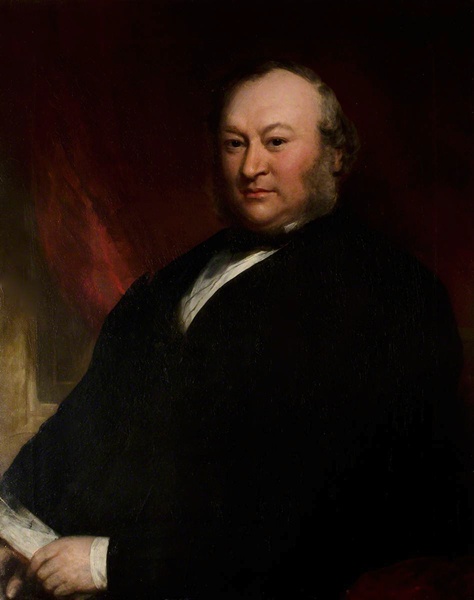
Run by subscription and used mainly by merchants and professionals, it occupied an uneasy position; it facilitated public discussion, yet access remained restricted. This raised clear questions about who truly spoke for the town. These tensions came to a head in 1816, when the local landlord interest, led by Viscount Kilmorey, held a meeting in the News Room to express support for Lord Castlereagh. The meeting was poorly advertised and held in a private setting, limiting attendance. Patrick O’Hanlon, a prominent local figure, strongly objected to it. Speaking within the News Room itself, he argued that decisions affecting Newry should be made openly and through proper public discussion, not by a small and select group meeting behind closed doors.
O’Hanlon was a significant and well-connected figure. He was the first Catholic in Ulster to be called to the bar after the profession opened to Catholics in 1793. His family had strong links to radical politics: his brothers Hugh and Felix fled Ireland as suspected United Irishmen, while Patrick himself avoided serious damage to his reputation during the 1790s. Admitted to Lincoln’s Inn in 1794, he remained in England until at least 1798, when he married into an Irish banking family in Liverpool with connections to the Holland House Whigs. After returning to Ireland, he left the law for commerce and was later appointed to the magistracy. O’Hanlon played a central role in opposing Lord Kilmorey’s efforts to tighten control over Newry through improvement and police commissions dominated by landlord nominees and estate officials. Working with his son, Hugh Marmaduke O’Hanlon, a barrister in London, he helped shape alternative legislation.
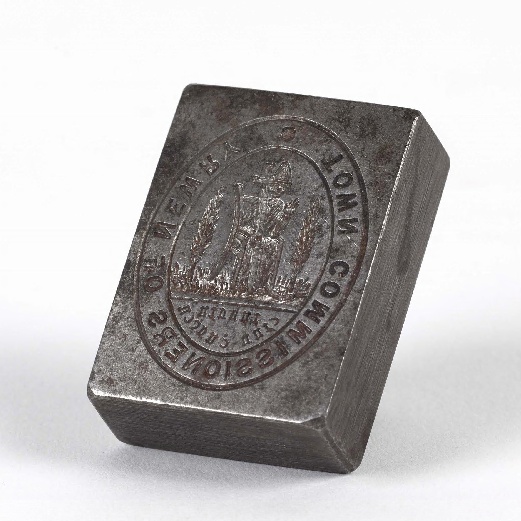
This led to the 1828 Act for the lighting, watching, and cleansing of cities, towns corporate, and market towns in Ireland. As a result, Newry became the first town in the United Kingdom to establish an elected town commission. Although voting was limited to property holders, the system gave a much wider section of the population a voice in policing and local improvements. Twenty-one Police Commissioners were appointed, making the body an important forerunner of later local councils. Dennis Maguire, the first Chairman of the Police Commissioners, was also the first Catholic to contest a Westminster election for the borough, though unsuccessfully in 1831 and 1832. The Police Commissioners oversaw the town watch, responsible for patrolling the streets, lighting lamps each evening, and keeping the town clean and free from obstructions.
The offices of the Commissioners of Police were recorded at No. 2 Pollock’s Court, High Street, in 1832. This was possibly the Commissions first office but by 1837, they appear to have moved into the News Room itself, with the Commissioners holding their meetings in their board room on the first floor. There is a striking irony here, a space once criticised for exclusivity, had become the boardroom of a more representative system of local government. The first town clerk appointed by the Commissioners was the former United Irishman John Melling, who also happened to be one of the leaseholders of the News Room.
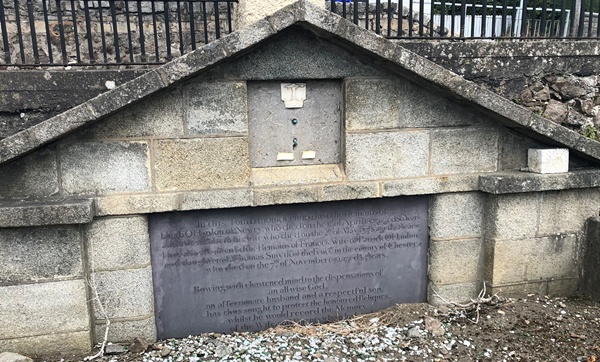
In 1865, the Board of 21 Police Commissioners was dissolved and replaced by 18 Town Commissioners. The first chairman of the Town Commission was John Moore, a prominent Justive of the Peace and successful merchant based in Abbey Yard. The new Town Commissioners focused on improving sanitation through sewer construction and the introduction of health regulations for public places, shops, and workplaces. These measures proved effective, with reported fever cases falling from 238 in 1864 to 48 in 1868. The Town Commission’s connection with the News Room ended in March 1875, when they moved to a new boardroom at 7 Marcus Square.
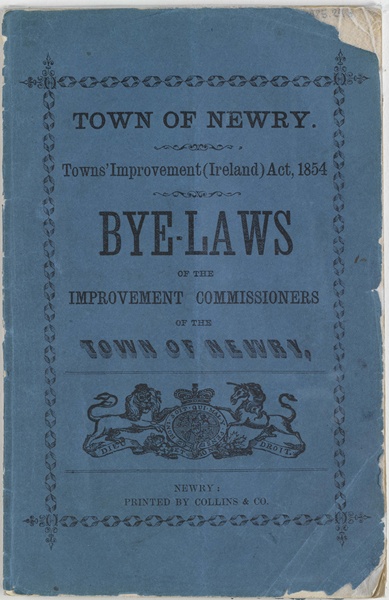
The Museum is currently offering free tours of the main exhibition galleries on Wednesdays at 2.00 pm. These must be booked in advance by calling our Education Officer at 0330 137 4422.
Newry and Mourne Museum is open Tuesday to Saturday 10.00 am to 4.30 pm. For further information call 0330 137 4422, email museums@nmandd.org or visit our website at www.visitmournegullionstrangford.com
Write a comment
Few objects capture the brilliance of Ireland’s early medieval past quite like the Tara Brooch. Dating from the late 7th or early 8th century, this extraordinary piece is widely regarded as one of the finest achievements of early Irish craftsmanship. Often mentioned in the same breath as the Ardagh Chalice, the brooch stands as powerful evidence of Ireland’s rich artistic and cultural heritage.
Visitors to the recently opened Categorically Celtic exhibition at Newry and Mourne Museum can now admire carefully crafted replicas of the Tara Brooch, offering a rare opportunity to appreciate its remarkable detail up close. The display invites audiences to explore not just the brooch itself, but the lasting impact it has had on art, identity and design. The original Tara Brooch is a pseudo-penannular design: a hooped ring with a pin and decorative terminals. Measuring 8.6 cm in diameter, with a pin extending an impressive 33 cm, it is larger and more elaborate than most Celtic brooches of its time. Crafted from gilt bronze, silver and gold, it is decorated on both front and back with exquisitely detailed filigree, enriched with enamel, amber and coloured glass.

Its surface is alive with interlacing patterns and stylised animal forms, reflecting the influence of the La Tène style, a design tradition that originated in Iron Age Europe and shaped Celtic art for centuries. The level of technical skill involved reveals a society where master metalworkers were highly valued and supported, capable of producing objects of astonishing complexity and beauty. More than an ornament, the Tara Brooch was almost certainly a symbol of high status or authority. It is believed to have been deliberately hidden during the 11th or 12th century, possibly to protect it from raiders or invaders at a time of political instability. That act of concealment may be the very reason it survived at all.
Its rediscovery in 1850 adds another layer of intrigue. According to tradition, the brooch was found buried along the beach at Bettystown, County Meath, by the children of a local woman. However, some scholars suggest it was more likely unearthed further inland, with the discovery location altered to avoid a landowner claiming legal ownership. The brooch soon came into the hands of Dublin jeweller George Waterhouse, who recognised both its cultural importance and its commercial potential. By naming it the “Tara Brooch”, he cleverly linked it to the ancient seat of Irish kings at the Hill of Tara, tapping into a growing fascination with national heritage. Waterhouse produced replicas and showcased them at major international events, including the Great Exhibition of 1851, where they caused a sensation. Queen Victoria herself purchased several examples.
These replicas became highly fashionable Victorian dress accessories and played a central role in the Celtic Revival, a movement that sought to celebrate Ireland’s ancient past through art and design.
Today, the original Tara Brooch is preserved in the National Museum of Ireland. Although it has suffered some damage over time, its extraordinary craftsmanship and visual power continue to inspire artists and designers. In the late 19th and early 20th centuries, figures such as Archibald Knox, working for Liberty & Co. in London, drew on its flowing lines and interlace patterns, helping to shape the emerging Art Nouveau style.
The Tara Brooch remains a potent symbol of artistic continuity, bridging ancient skill with modern creativity. From Irish dance costumes to contemporary tattoo art, its motifs continue to be reinterpreted in new forms. As the Categorically Celtic exhibition shows, this remarkable object is not just a treasure of the past, but a living influence at the heart of Ireland’s cultural story.
Visit before September to experience this conversation across time and tradition and to find your own thread in the knotwork. Newry & Mourne Museum welcomes individuals, families, schools, and community groups; keep an eye on social media for talks and activities linked to the exhibition.
The Museum is currently offering free tours of the main exhibition galleries on Wednesdays at 2.00 pm. These must be booked in advance by calling our Education Officer at 0330 137 4422.
Newry and Mourne Museum is open Tuesday – Saturday 10.00 am – 4.30 pm. Please call 0330 137 4422 or email museums@nmandd.org for further information.
Visit their website at www.visitmournegullionstrangford.com/
Write a comment
From the seed and florist business of Joseph Doyle to the world-renowned success of the Daisy Hill Nurseries, Newry has had a rich history in the flower industry. This week Newry and Mourne Museum will look back on the history of floriography, the language of flowers.
While the practice of floriography can be traced back to several time periods and cultures, it was seeing the use of flowers as a code during her visit to Turkey that prompted aristocrat and writer Lady Mary Wortley Montagu to introduce the concept to English society in the early 1700s. In one of her famous Turkish Embassy letters, published after her death in 1763, she writes: “There is no colour, no flower, no weed, no fruit, herb, pebble, or feather, that has not a verse belonging to it; and you may quarrel, reproach, or send letters of passion, friendship, or civility, or even of news, without ever inking your fingers.”
Other countries would also take interest in the subject with several books being published on the topic. Joseph Hammer-Purgstall, was considered the first to publish a list of flowers and their corresponding meanings in 1809. Other noted works include the book Le langage des Fleurs written by Louise Cortambert, writing under the pen name Madame Charlotte de la Tour.
Interest in the subject grew during the Victorian period with the publication of The Sentiment of Flowers; or Language of Flora by writer and clergyman Robert Tyas in 1836. The book was similar to Cortambert’s work although the book states it is not a mere translation of the text and that “a discretion has been exercised in the rejection or alteration of those passages which were not suited for English taste.” This reinforces the idea that while Tyas refers to flowers as “the alphabet of the angels” their symbolism can be open to different interpretations. For example, according to Tyas’ book, yew trees were considered sad and gloomy whereas older cultures would associate the tree with rebirth. Newry’s name came from the translation of Iúr Cinn Trá, (the yew tree at the head of the strand) wherein the yew trees planted were seen as a symbol of growing faith.
One way in which the coded messages were sent during the Victorian era was via small bouquets known as tussie-mussies or nosegays. While they existed during medieval times as a method of combating foul odours and promoting healthy well-being, they evolved into a fashion statement and a romantic form of communication.
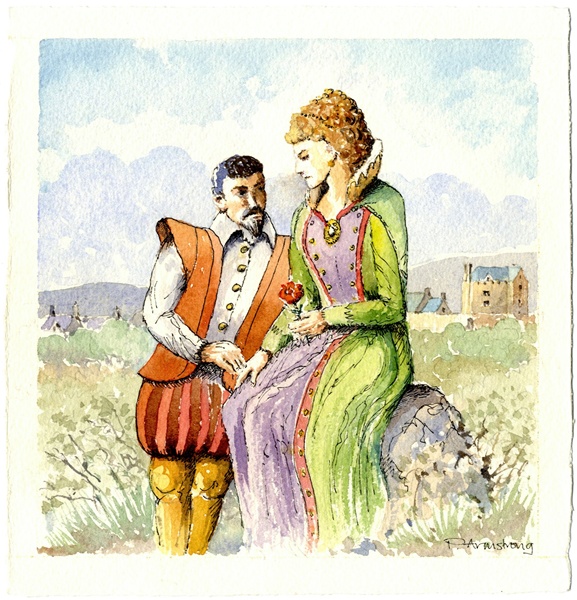
Aside from the physical form, flowers were used in art to further emphasis the themes of the piece. Noted works include the 1850s painting of Ophelia by John Everett Millais which uses daisies, violets and willows to portray innocence, faithfulness and forsaken love. The museum collection holds a watercolour interpretation of Mabel Bagenal and Hugh O’Neill painted by Philip Armstrong depicting the love affair between the two with the use of a red rose, the symbol of romance.
Other examples of floriography in the collection include the use of shamrocks to symbolise good luck and Irish identity on glasses commemorating Northern Ireland participating in the FIFA World Cup in Spain in 1982 and Christmas cards featuring poinsettias as an expression of generosity, goodwill and holiday spirit.
The Museum is currently offering free tours of the main exhibition galleries on Wednesdays at 2.00 pm. These must be booked in advance by calling our Education Officer at 0330 137 4422.
Newry and Mourne Museum is open Tuesday – Saturday 10.00 am – 4.30 pm. Please call 0330 137 4422 or email museums@nmandd.org for further information.
Visit their website at www.visitmournemountains.co.uk
Write a comment
St Brigid of Kildare (c. 451–525) is one of Ireland’s most enduring and resonant figures, bridging ancient belief and early Christianity. Long before she was venerated as a saint, Brigid was revered in pre-Christian Ireland as a goddess associated with healing, fertility, poetry and craftsmanship. These qualities carried seamlessly into her Christian legacy, where she became closely linked with care for people, land and community.
One of the best known stories connected to Brigid is the legend of her cloak, or Brat Bhríde. Seeking land to build a monastery at Kildare, Brigid asked the King of Leinster for only as much land as her cloak could cover. When the king agreed, Brigid instructed her companions to take the cloak’s corners and walk in opposite directions. As they did so, the cloak expanded to cover acres of fertile ground. Often read as a story of generosity and cleverness, the legend also speaks to collective action and shared responsibility for land and shelter.
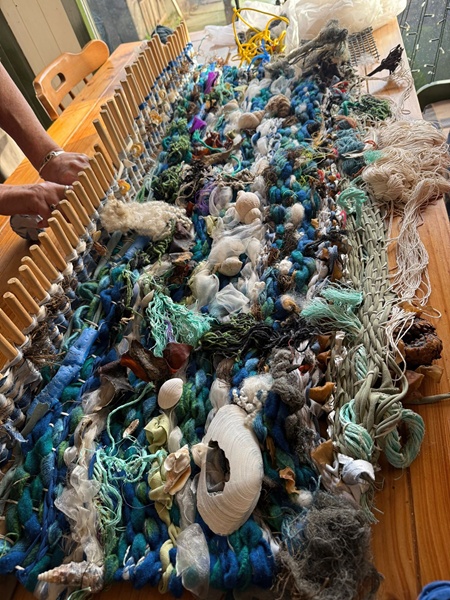
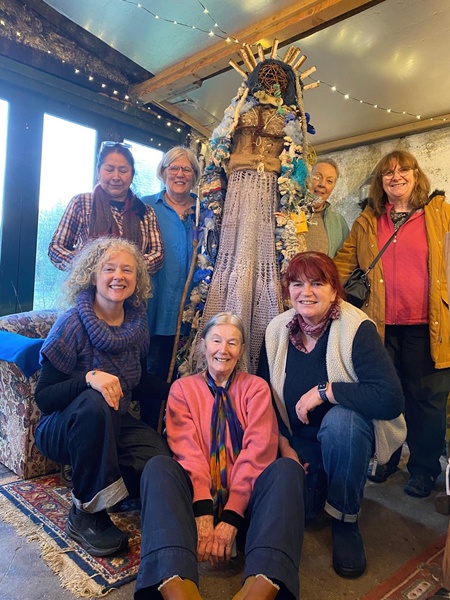
This ancient story has found a powerful contemporary expression at Newry & Mourne Museum through Brigid and the Brat Bhríde, a collaboratively woven cloak created by Interwoven, a subgroup of the Dolmen Climate Change Network. Woven over ten weeks using reclaimed fibres and materials gathered from local beaches, the cloak brings St Brigid’s symbolism into direct dialogue with one of the most pressing environmental challenges of our time: pollution caused by fast fashion. Modern fast fashion prioritises speed, volume and low prices, producing garments designed to be worn briefly and discarded. Many of these clothes are made from synthetic fibres which shed tiny plastic microfibres when washed. These fibres pass through wastewater systems and enter rivers and seas, accumulating in marine life, sand and seaweed.
For coastal communities, this global problem is increasingly visible. Beach walks today often reveal frayed threads, tangled fibres and fragments of fabric embedded among natural materials. These remnants tell a story of distant production and consumption washing up on local shores. In Brigid and the Brat Bhríde, these discarded materials are gathered, woven and made visible, transforming pollution into an artwork that prompts reflection rather than denial.
The cloak forms the centrepiece of Fashioned by Nature, a programme of free talks, workshops and creative events currently taking place at Newry & Mourne Museum. The programme explores the environmental and economic impact of fashion from the 18th century to the present day, using Newry’s history as an international port to examine how global trade in dyes, fibres and materials shaped fashion, altered ecosystems and affected communities worldwide.
Fashioned by Nature is part of, and supported by, Fixing Our Broken Planet, a major initiative led by the Natural History Museum in London, which encourages science based, hopeful responses to the climate crisis. At Newry & Mourne Museum, this global framework is interpreted through local history, creativity and participation. The programme launched on Thursday 23 April with a public unveiling of Brigid and the Brat Bhríde.
Hands on engagement continues Saturday 25 April (11.00–16.00) with The Exploding Wardrobe, a talk by textile artist and academic Gillian Steel followed by a drop in mending workshop. Participants can print their own fabric patches and learn decorative Japanese Sashiko stitching techniques, highlighting repair as both a practical life skill and a quiet challenge to disposable fashion culture.
Talks form a central strand of the programme. On Saturday 2 May at 11.00, curator and author Charlotte McReynolds will speak about Ashes to Fashion: A Collection Reborn, recounting how the Ulster Museum’s original textile and dress collection of over 10,000 items was destroyed by fire in 1976, and how, 50 years later, it has been rebuilt into a stronger and more representative collection.
Creative exploration continues on Sunday 3 May (11.00–16.00) with a stop-frame animation workshop led by artist and filmmaker Kevin Cameron. Working in small teams using clothing, simple props and iPads, participants will create short, animated films exploring fashion and sustainability. No previous experience is required, making the workshop accessible to all ages and backgrounds.
The programme concludes on Saturday 9 May at 11.00 with a talk by Newry & Mourne Museum curator Shan McAnena, focusing on the region’s historic embroidery industry known as flowering. This industry employed thousands of local women working from home in the 19th and early 20th centuries, offering an important reminder that fashion has long been embedded in local lives, labour and creativity.
Through the lens of St Brigid’s expanding cloak, Fashioned by Nature asks audiences to consider how clothing connects us to land, labour and responsibility. Just as Brigid’s cloak spread through collective effort, our everyday choices about what we wear, mend and discard ripple outward, shaping environments far beyond our sight.
For further information about the Fashioned by Nature programme and how to book for these free events please visit www.visitmournegullionstrangford.com or contact Declan Carroll, Education & Outreach Officer declan.carroll@nmandd.org.
The Museum is currently offering free tours of the main exhibition galleries on Wednesdays at 2.00 pm. These must be booked in advance by calling our Education Officer at 0330 137 4422.
Newry and Mourne Museum is open Tuesday – Saturday 10.00 am – 4.30 pm. Please call 0330 137 4422 or email museums@nmandd.org for further information.
Visit their website at www.visitmournegullionstrangford.com



 |
 |
 |